
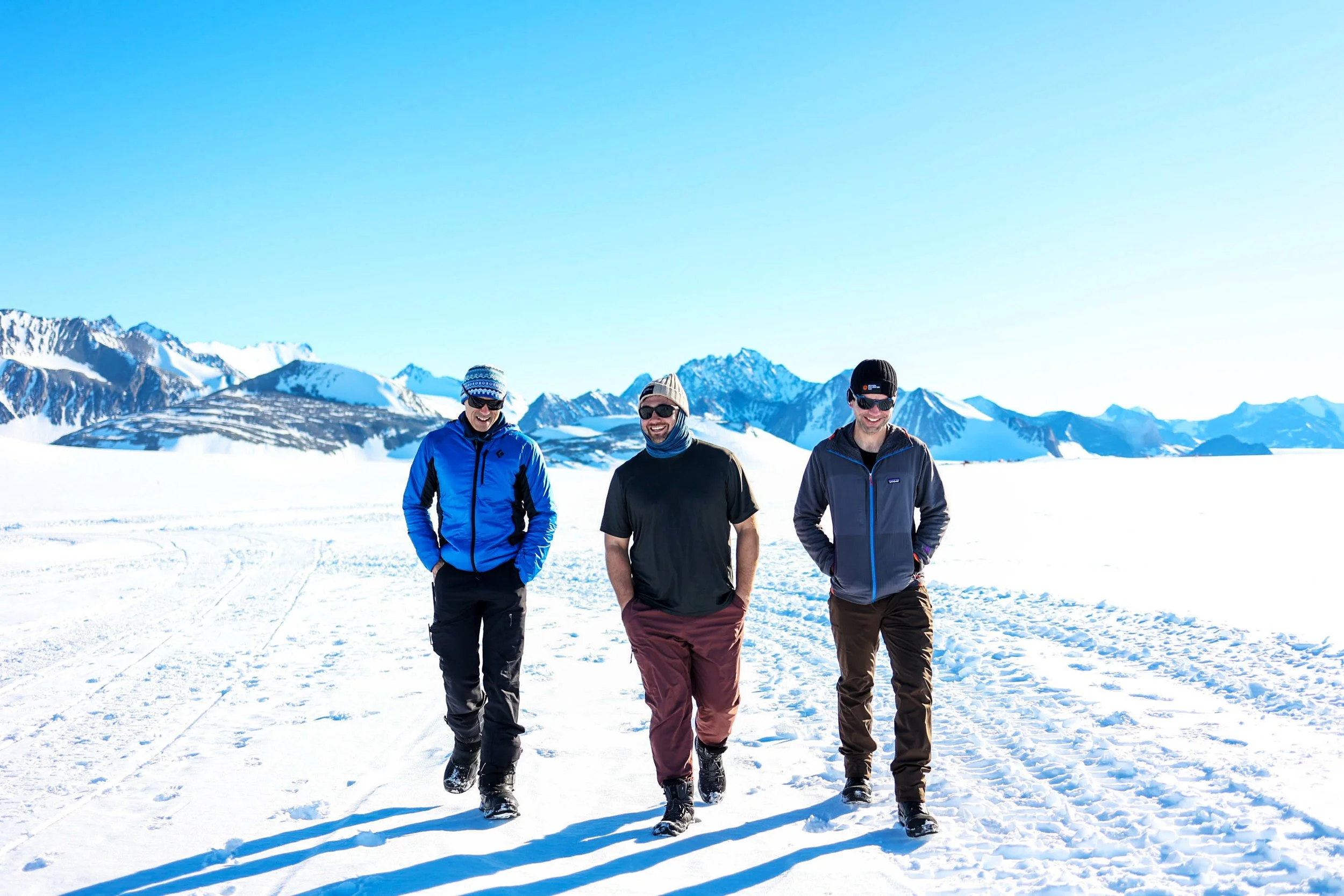
Union Glacier, Antarctica | 79.75° S, 82.50° W | November 26, 2025
What I’d experienced in all the bases I had visited, was the gratifying, enticing closeness that comes when – in a place that was famous for its hostility –
you found such like-minded people who invited you in so readily.
— Gabrielle Walker, Antarctica
Flying to Antarctica feels like an ethereal dream. From an altitude of 30,000 feet, cruising at 500 miles an hour, I can see glaciers so bright they appear to glow and mountains that conjure a primal sense of reverence. A literal dreamscape.
Staring out the window, I think about my last journey to Antarctica aboard the hulking Laurence M. Gould. Sailing out of Punta Arenas, Chile and crossing the Drake Passage took four days. I didn’t get seasick but the lumbering waves left me feeling deliriously sleepy and disoriented.
On this short and sweet flight, I feel wide awake — and extremely happy.
Three and a half hours after take-off, the flight attendants announce the start of our descent and instruct us to begin donning our polar clothing, taking special care to use sunscreen, eye protection and gloves. I pull on additional layers and slather on more sunscreen, glancing around at other passengers doing the same. The pilots lower the temperature on the plane. The anticipation is palpable.
We will be landing in the interior of western Antarctica, near the Ellsworth Mountains. There is no airport, but a unique blue ice runway, made of hard, compacted glacial ice (and regularly cleared of snow by Katabatic winds) enables large planes, like this Boeing 757, to land here.
A minute after we touch down, one of the flight attendants picks up the intercom. “Welcome to Antarctica,” she says in a whimsical voice. “We hope you have an unforgettable time in this extraordinary place.”
Still feels like I’m in a strange, beautiful dream. But now I need to stop gazing out the window and get off the plane.
Fumbling with three bags, I awkwardly shuffle down the aisle. The flight attendants eye me warily. Stepping through the airplane door, a huge burst of wind knocks me backwards. My sunglasses immediately fog up and I can barely see as I make my way down the stairs. A medic stands at the bottom, yelling over the wind: “It’s very slick. Be extremely careful.”
I step gingerly, shifting the weight of my bags, seeing only blurry shapes. Once I get away from the plane, I wipe the condensation from my sunglasses and gaze at the massive blue ice runway and surrounding mountains in disbelief. With the intense wind and radiating sunlight, I struggle to snap a few photos before making my way towards a woman holding a sign that says CalTech Science.
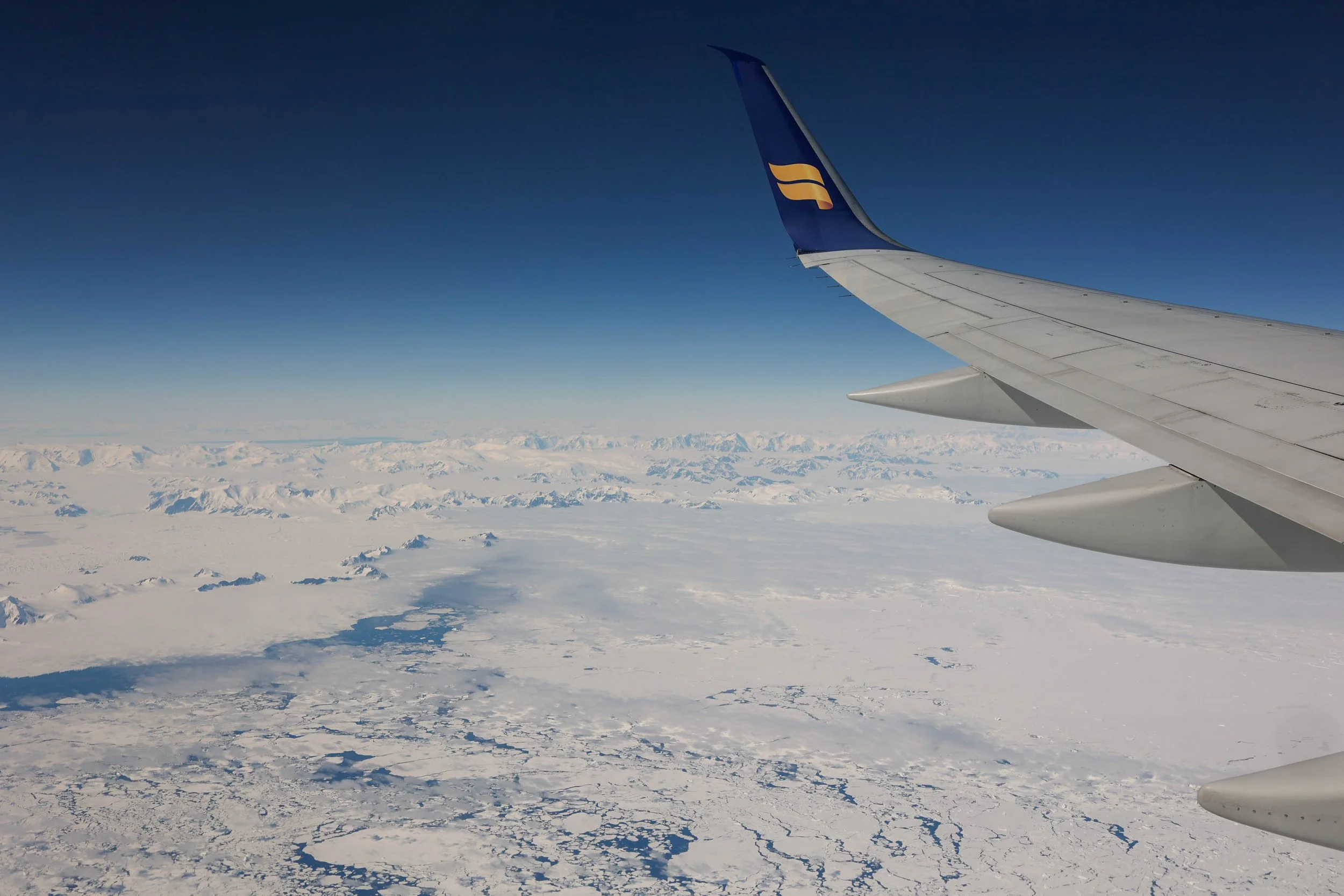
Epic views: I spend most of our four-hour flight staring out this window and taking tons of photos.
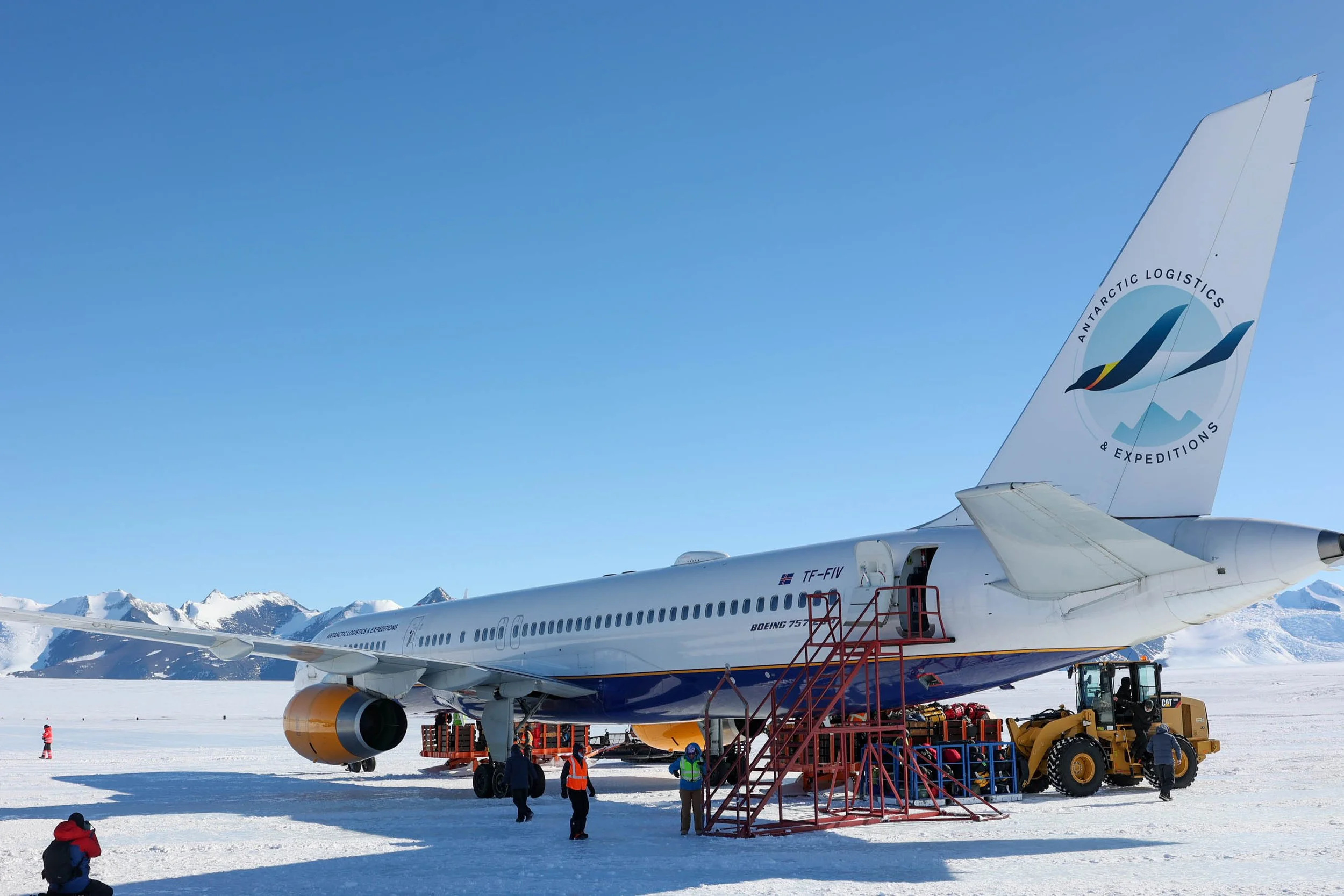
Smooth landing: ALE personnel unload the Boeing 757 on the most beautiful runway in the world.
Our expedition team squeezes into a custom all-terrain vehicle, along with a group of mountaineers who came here to climb Mt. Vinson. I sit next to a British guy who tells me about the other summits he’s bagged (Kilimanjaro and Denali, but not Everest — yet). They are all set on conquering the Seven Summits or the Explorer’s Grand Slam, which includes the Vinson Massif (elevation 16,050 feet) here in Antarctica. These mountaineers are the typical type of clients Antarctic Logistics and Expeditions (ALE) serves.
I wonder vaguely about what it would be like to vacation in Antarctica. I would love to climb any mountain down here, but the hefty price tag would make it completely unfeasible for me. Once again, I feel honored and humbled to be in this wild, remote place for work.
We arrive at Union Glacier about 20 minutes later. A cheery British woman gives us a warm welcome, instructs us to drop our backpacks on the ice, and promptly begins our welcome tour around camp.
First things first: the toilets. To complete the arduous task of transporting human waste off the continent, ALE staff need to separate liquid and solid waste. Each bathroom contains two toilets and signage with specific instructions for each. An industrial container of hand sanitizer sits on the counter in place of a sink.
“Water is like gold here,” our guide says, as she shows us the shower facilities. “We ask that you limit your shower use to twice a week.” Then she demonstrates how to fill a bucket, insert a hose, and turn on the water to generate three minutes of hot, running water.
Next up is our accommodations: large, dome-shaped tents called “clams”. Each tent is large enough to stand in and comes equipped with a table and two cots. We also stop by the lounge, which includes plenty of comfy seats and a small library stuffed full of books about Antarctic exploration. For the few days we’re here, ALE staff have provided a work tent for our gear and equipment. We are happy to see it comes with tables and plenty of electrical outlets for charging everything.
The tour ends at the dining hall, referred to as the Fram. Meal times are set for the same time each day: breakfast at 0800, lunch at 1300, and dinner at 1900, but the Fram is open 24-hours and well stocked with snacks and drinks. We’ve heard the food here is outstanding and we are not disappointed. It’s not yet dinnertime, but we help ourselves to fresh bread and creamy potato soup, as well as tea, cookies, nuts, chocolate, and cake.
I knew a bit about what to expect at Union Glacier thanks to the ALE website and this great video: A Very Short Guide to Union Glacier Camp, Antarctica.
But I am still blown away. This place is incredible — and surreal.
“It’s a wild juxtaposition,” Joel Steinkraus tells me later. “Here we are — on a massive glacier, in the planet’s most true wilderness — but we’re also walking into spacious tents, and the library with comfy chairs and ottomans, and eating freshly baked cookies.”
After enjoying the delicious snacks, we head to the work tent for our first official team meeting in Antarctica. Like every adventure ALE facilitates, our scientific expedition requires massive effort and expertise from several highly skilled and experienced people. Five members of the ALE staff will be integral to our time here. Nick Lewis (an owner of the company) has been accompanying us since our journey began in Punta Arenas. Now we meet Darren McAulay and Josh Hoeschen, who have both spent 13 seasons with ALE, and Patrick Saylor who is new to ALE but has extensive experience guiding on Denali. We are also incredibly fortunate to have Patricio (Pato) González, who will be cooking all of the meals at our field camp.
After the introductions are done, we chat briefly about logistics and plans, then walk outside so the team can determine where and how they will conduct tests on their instruments over the next two days. Josh points out an area of camp called the “playground”, a large, open space adjacent to the clam tents.
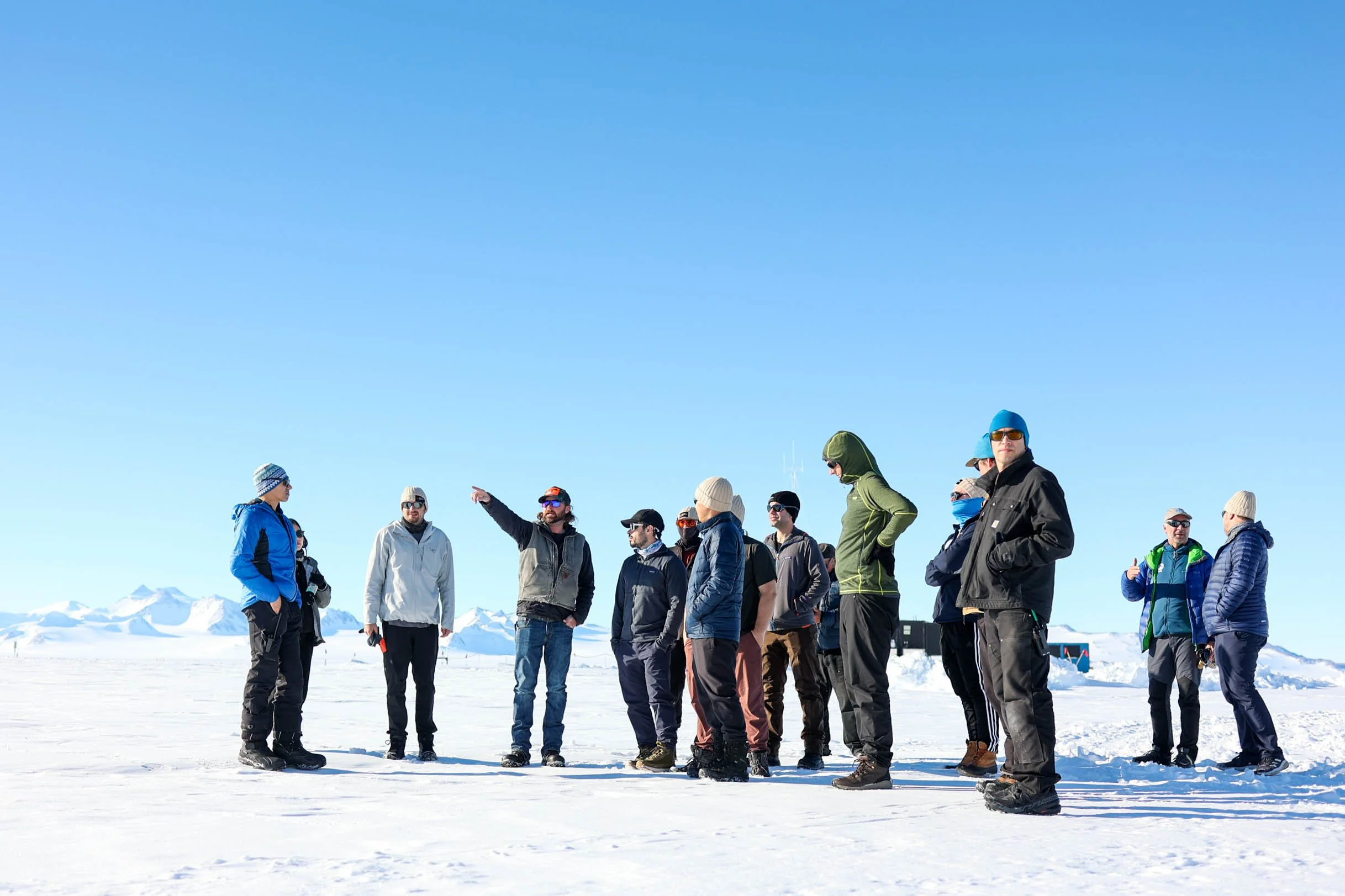
A place to prepare: Josh Hoeschen points out areas where the team can deploy their instruments for testing.
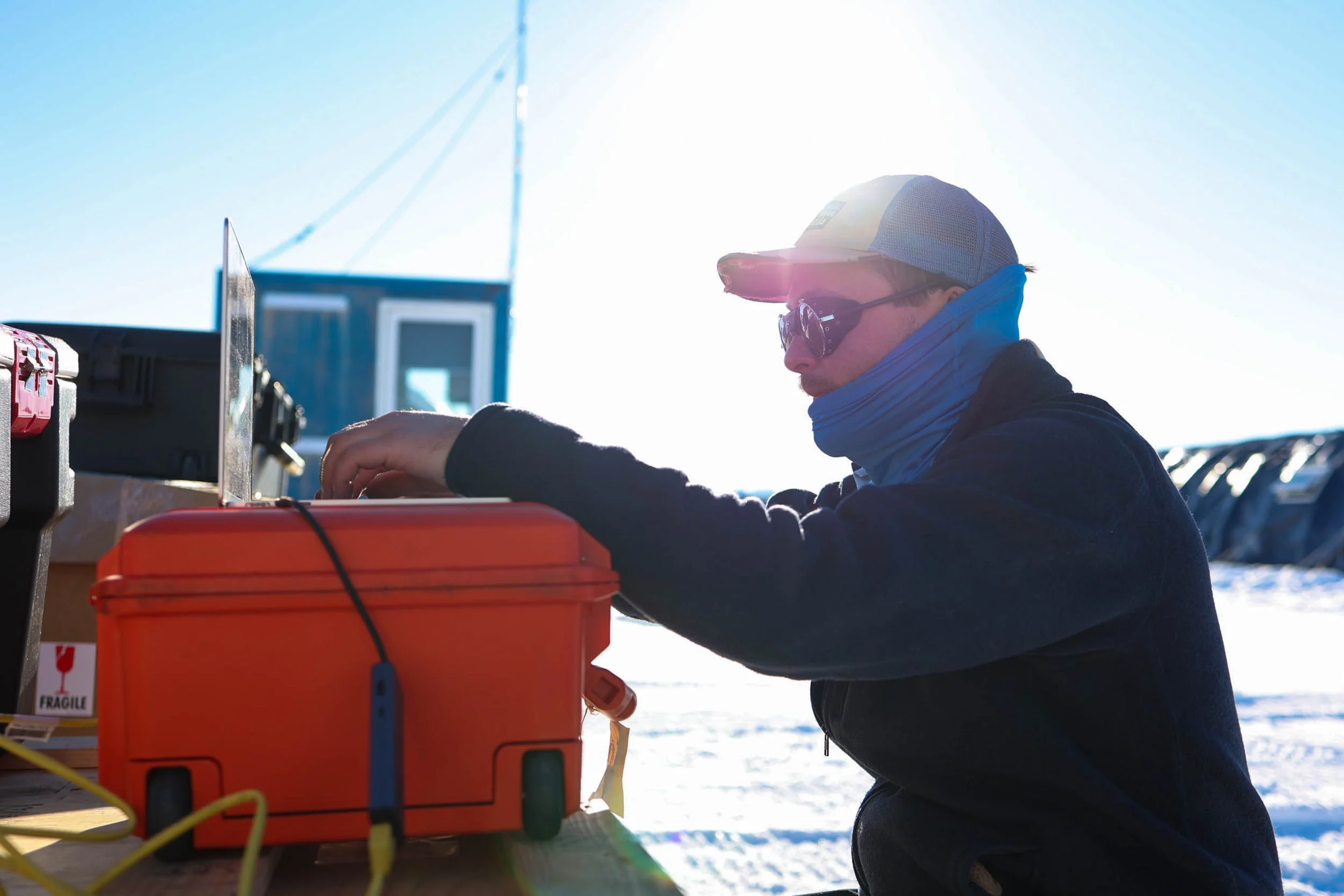
Systems check: Thatcher Chamberlin conducts a loop-back test to check that his radar system is functional and performing well after our long journey.
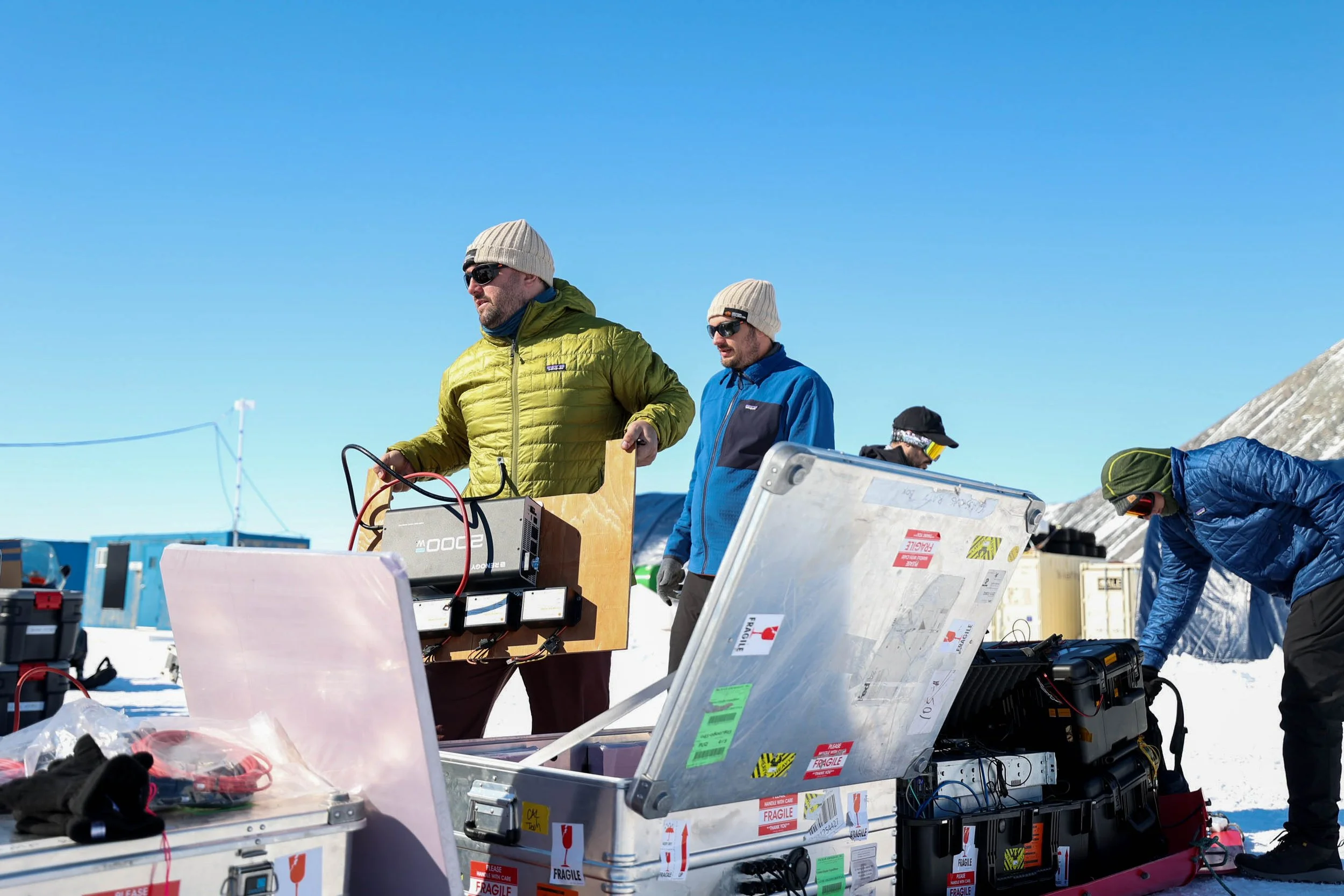
Power to go: Joel Steinkraus unloads a component of the solar power system that will be used to charge batteries and provide power for various instruments.
I head to bed around 11pm, with the sun still blazing high in the sky. Trying to sleep in 24-hour daylight is strange, to say the least. I drift off shortly after midnight, then wake up around 2am, convinced it must be time for breakfast. It’s the most bizarre “night” of sleep of my life, but I manage to get a few hours of rest. When I step out of my tent around 6:30am, I stare at Mt. Rossman, a stunning wedge-shaped peak right next to camp. I spin in a small circle, taking in the 360 degree mesmerizing view of snow, ice, and mountains.
Still feels like I’m dreaming.
It doesn’t take long for Union Glacier (UG) to feel cozy and familiar. While the vibe is different from the only other base I’ve visited in Antarctica (Palmer Station), hospitality and kindness abound. Everyone I meet is charismatic and curious. Union Glacier has hosted countless photographers and film crews over the years, but most are commercial operators (a Netflix crew was just here last week). Several folks ask about how I got into documenting scientific research.
Walking around camp with my camera, I ponder the inner workings of this place, from the personnel to the food to the infrastructure. At dinner, I pepper Nick with questions. How many people work here? How long does it take to set up camp at the start of the season? How often do they receive supplies from Chile? In short, how do they pull off the mind-boggling task of creating this temporary community at the bottom of the world?
I’m sure Nick has been asked these questions many times over the years but he answers them with enthusiasm. “It wasn’t always like this,” he says, smiling. “It’s taken a long time to build it up to this level.” About 100 people work at Union Glacier for their three-month season. The start-up crew usually arrives in late October, and the season officially begins in early November, running through late January. They operate weekly flights from Chile, with the Boeing 757 bringing clients and the Ilyushin IL-76 TD delivering cargo.
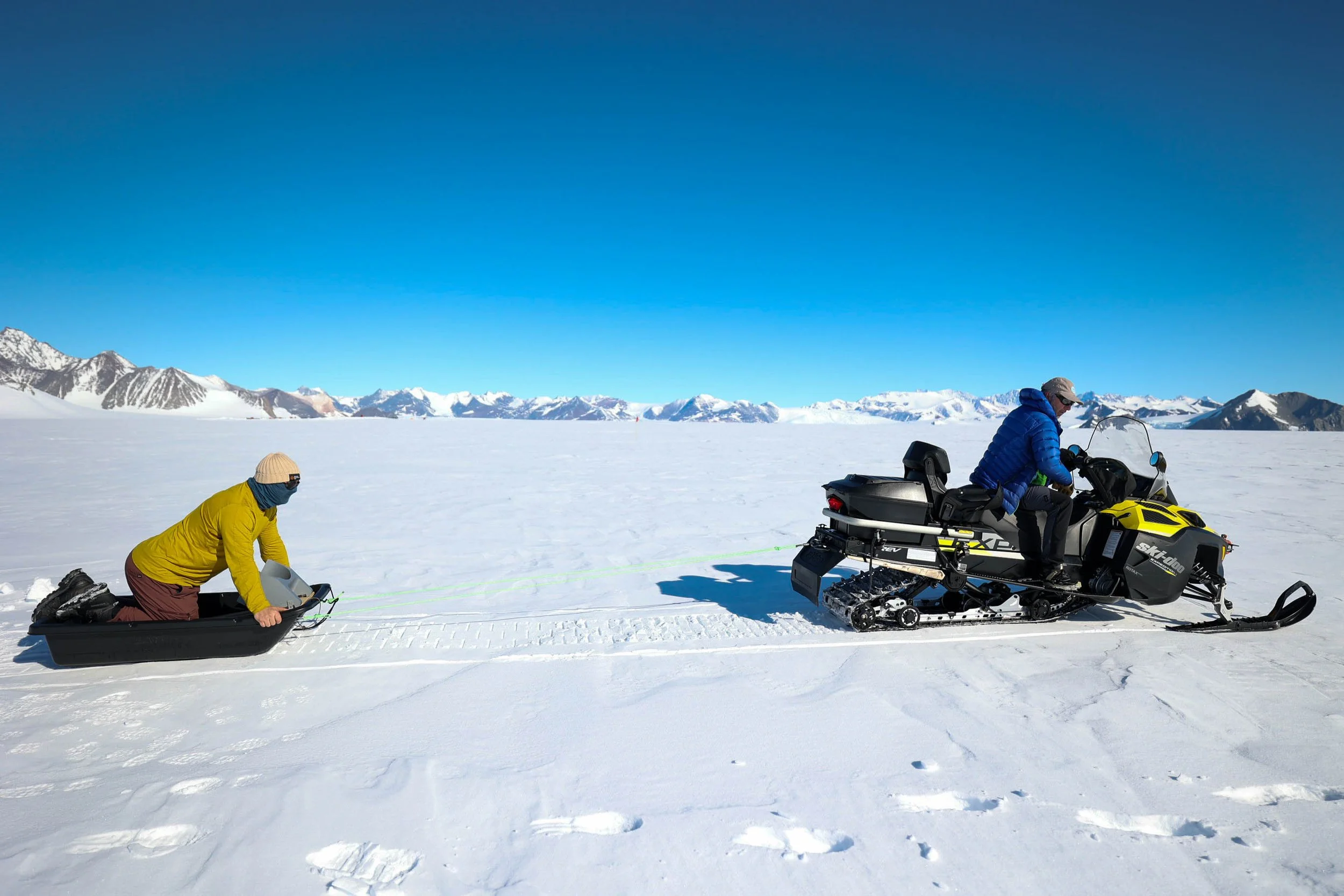
Sledding for science: Darren pulls Joel in the custom sled that will deploy the 5km fiber on the Ronne Ice Shelf.
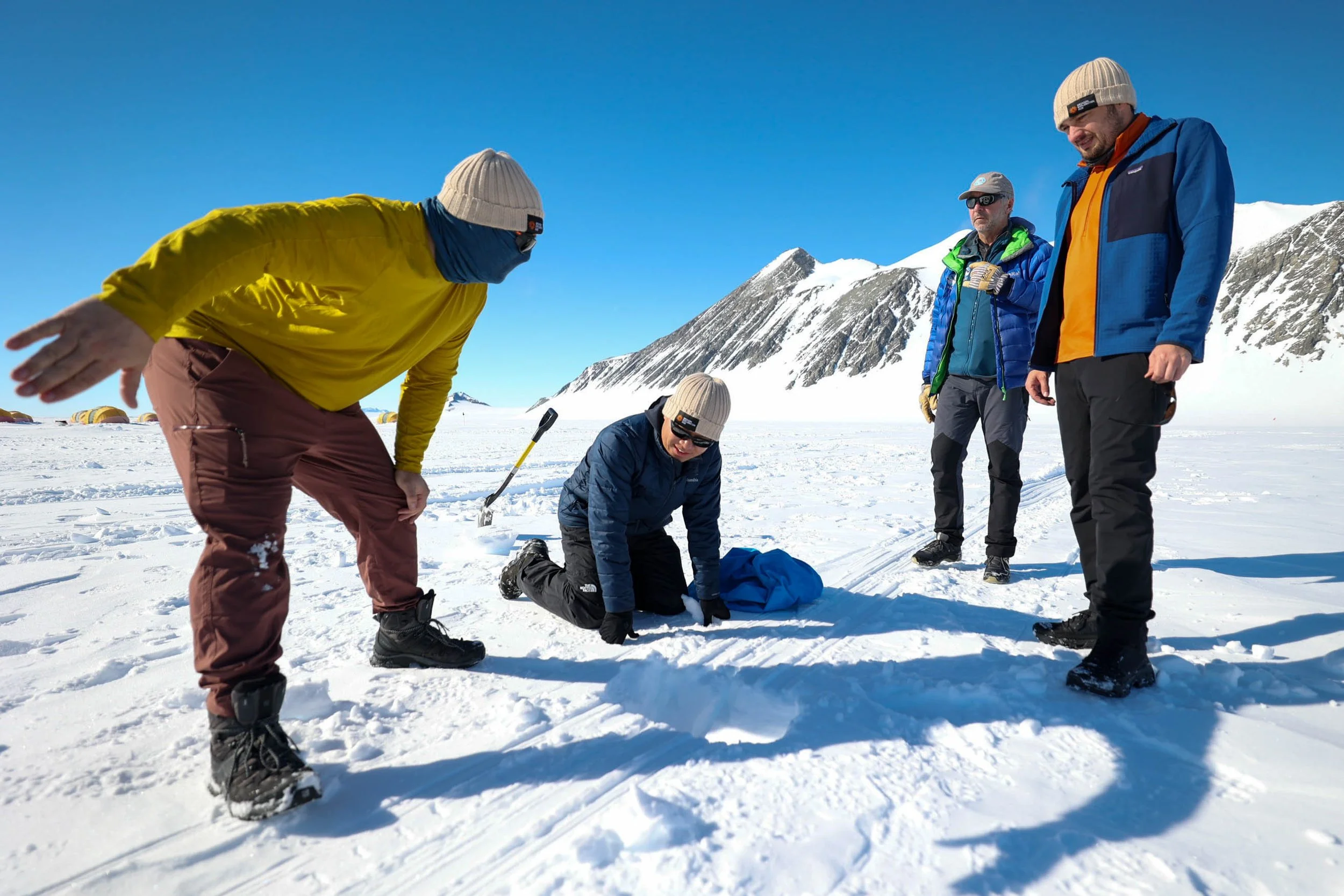
Down the line: After the initial fiber deployment, the team assesses its efficacy and discusses plans for improvement.
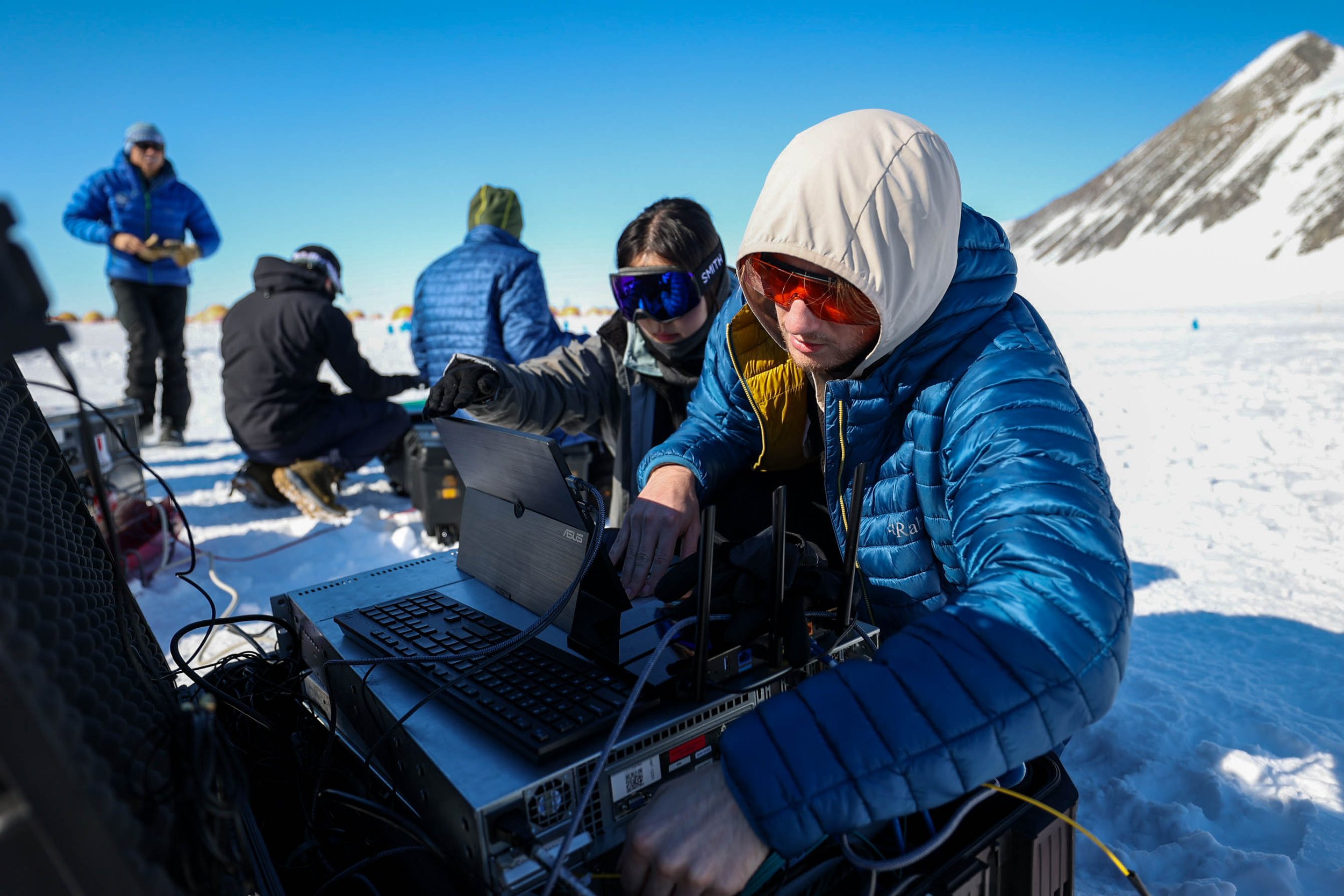
Wrangle the fiber: Soyeon and Auden ensure the fiber is coupled adequately to the snow so that it can efficiently receive acoustic waves.
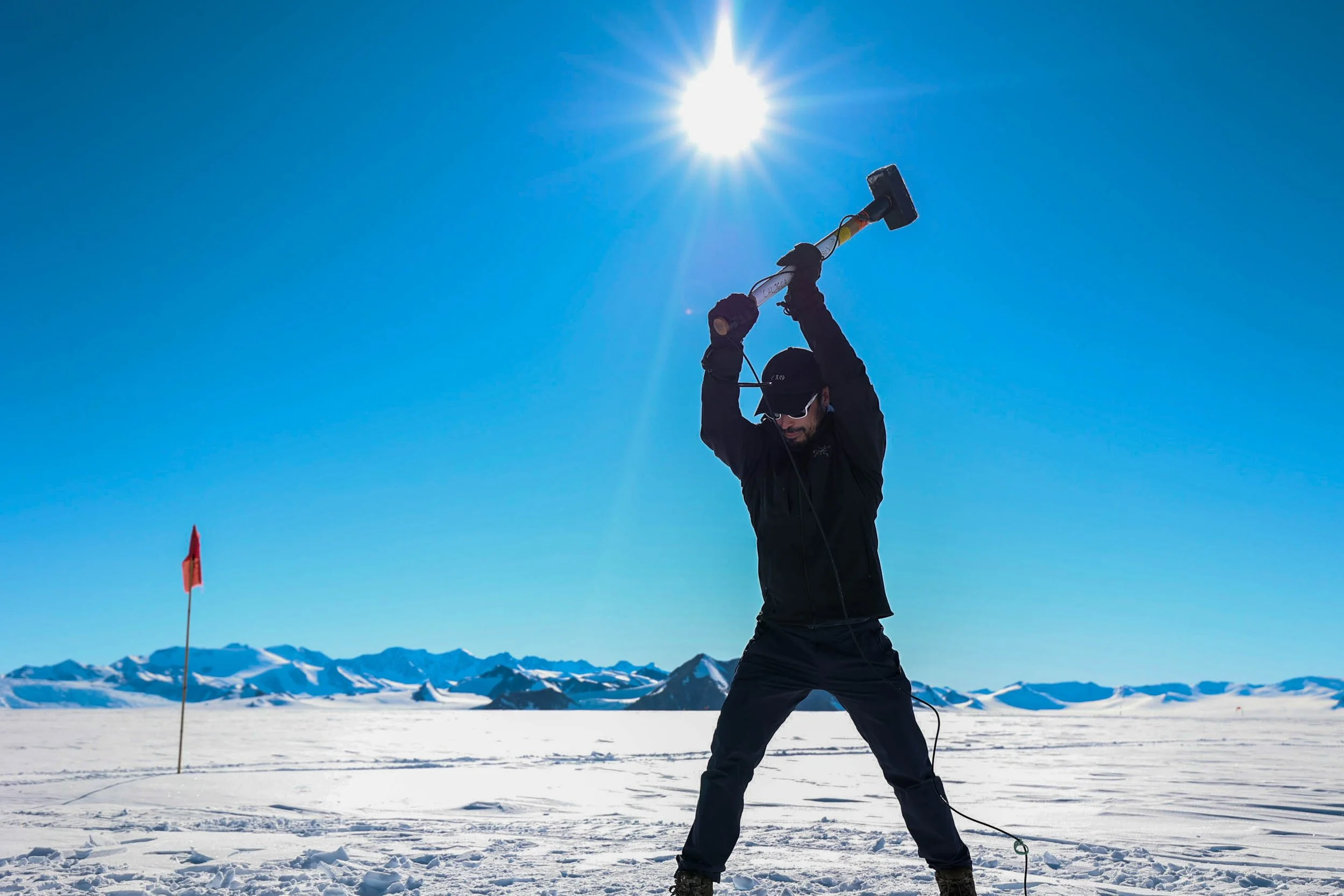
Slam it: Luis Costa raises the sledgehammer to hit the 3×3 striker plate that serves as a load spreader, generating a signal that gets recorded on our instruments.
At lunch the next day, Pat and I chat about our professional backgrounds and how we ended up with jobs in Antarctica.
“This was never on my radar,” I say, glancing out the window at the glaciated mountains. “When I was in college, I had no idea I would end up doing this kind of work.”
Pat grins. “I don’t think any of us did.”
He tells me about his time in the Navy and I tell him about my work on research vessels. It’s always heartening to meet another boat person, especially in a totally different environment. We discuss the similarities between living on a ship and living in a place like Union Glacier. The rules for being a good shipmate (kindness, flexibility, and adaptability) certainly apply here.
In the afternoon, I learn about all the geophysical equipment and technology we’ll be using during this expedition. The most critical instruments are the two DAS (Distributed Acoustic Sensor) systems. One is a commercial model, while the other is a rugged, low-power, lightweight unit developed in house at the Brinson Exploration Hub.
The team runs through their task list efficiently: asses the AP Res and towed radar system, take measurements to confirm their functionality, and ensure their settings are calibrated for the glacial environment. Charge and test the SmartSolo and STRYDE geophones. Meanwhile, ALE staff evaluate the power systems of the GNSS stations, then charge and install batteries so that they are ready to deploy.
In the evening, I take photos of the team by the Union Glacier sign, laughing at their spirited poses. This group includes brilliant people from the NASA Jet Propulsion Laboratory, CalTech, and MIT, but they don’t take themselves too seriously. I delight in documenting everyone acting like kids on Christmas morning.
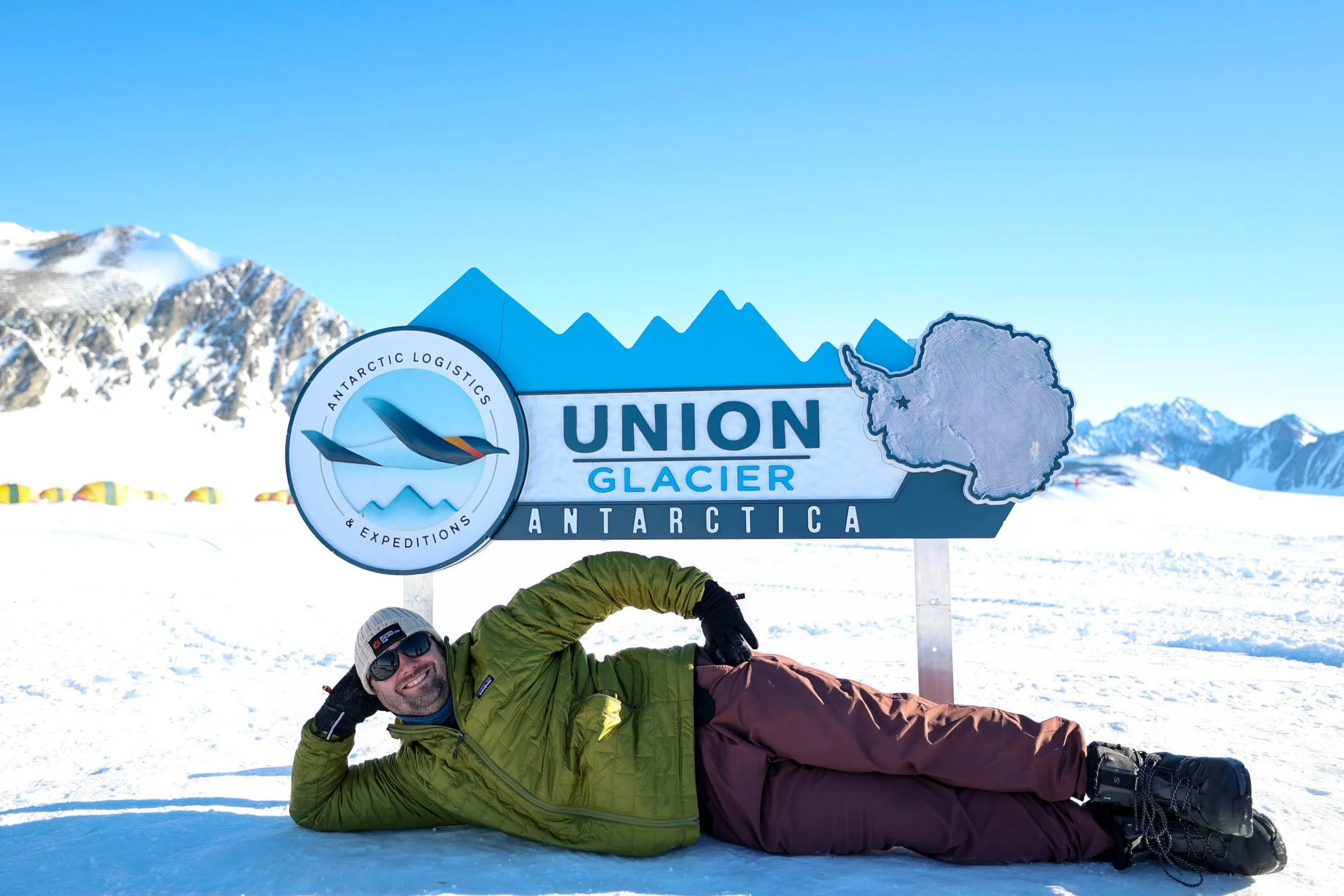
Our fearless, fabulous leader: I quickly learn that Joel Steinkraus is not your typical engineer.
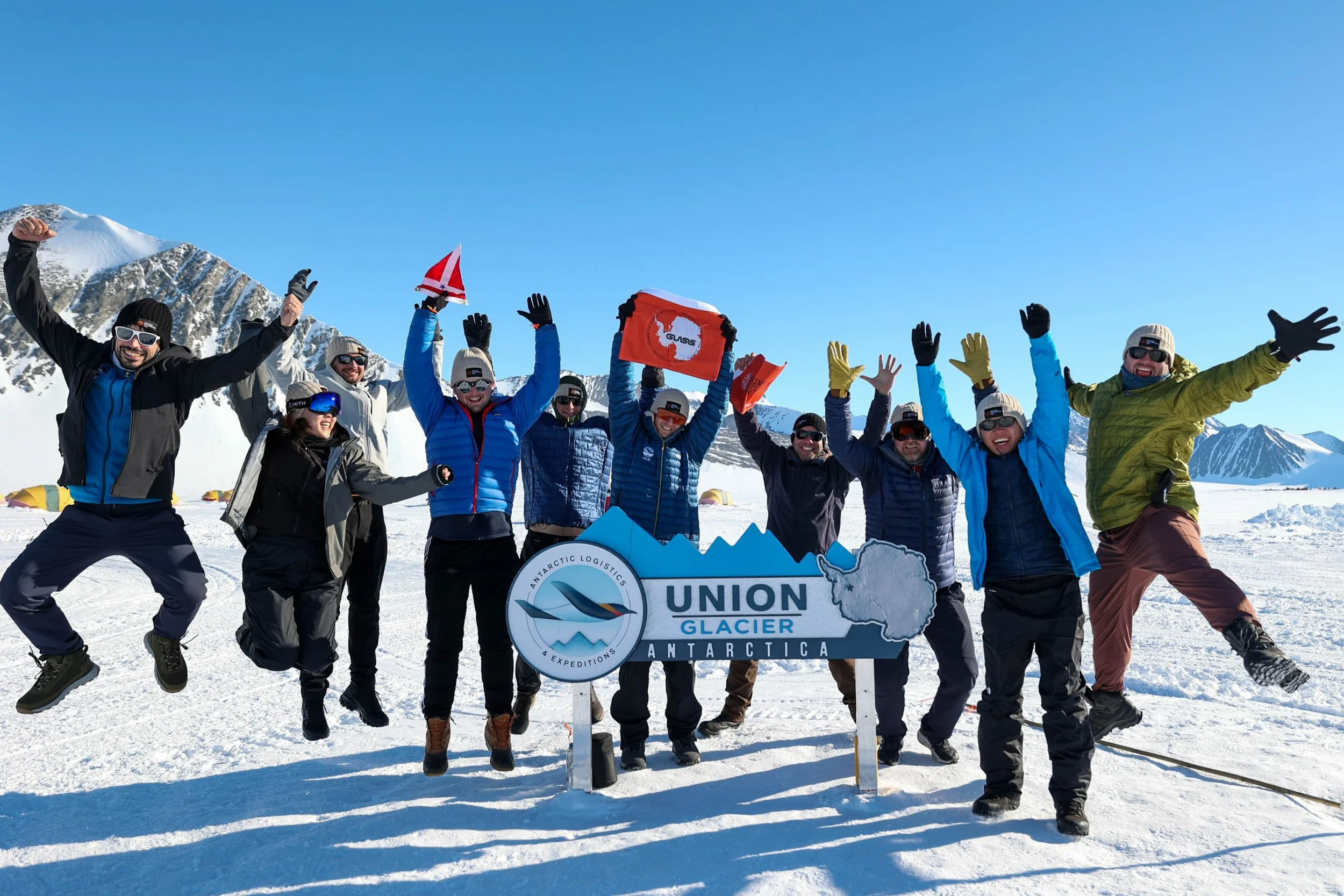
The stoke is real: Our entire team is delighted to be here.
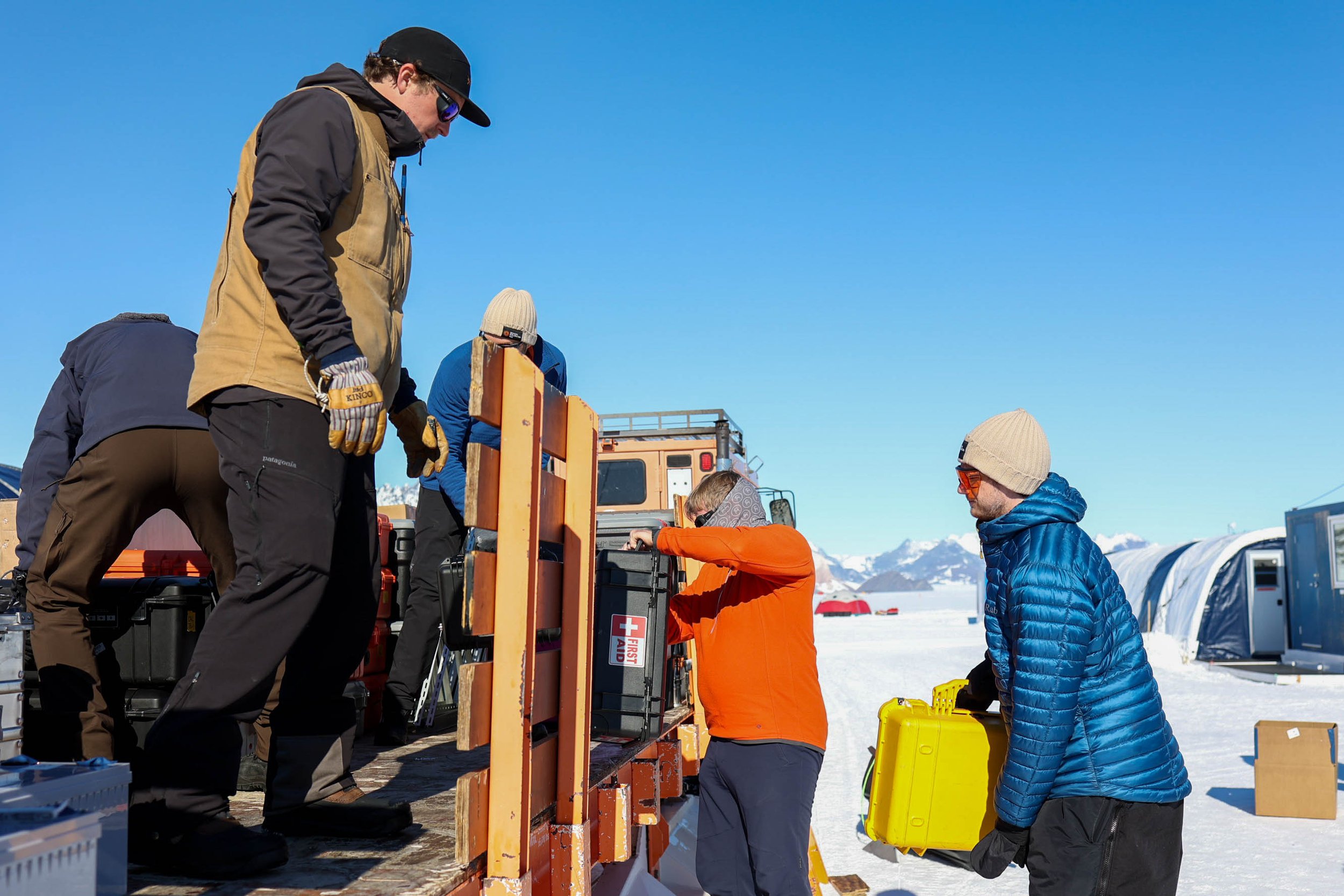
Ready to roll out: Auden hands a pelican case to Pat as the team loads all the heavy equipment onto a large sled. We’re taking a short flight to get to our field camp, but Josh will transport this gear overland using a Tucker Sno-Cat.
The next morning, I take a three-minute bucket shower, savoring the last stream of hot water my body will feel for the next two weeks. In a few hours, we’ll board a ski-equipped DHC-6 twin otter, fly over the mountains, and get dropped off on the Ronne Ice Shelf.
Back in my tent, I unpack, organize, and repack my Patagonia duffle bag (again) prioritizing what I’ll need at the field camp. I’m leaving a bag of non-essential items here in UG, but I make it a point to stash a small notebook in my backpack. When I finish packing, I take a minute to jot down the following:
My fingers are a bit numb so writing is difficult but I couldn’t be happier. Beautiful weather. The most stunning landscape I’ve ever seen and happy vibes amongst the team. I love witnessing the joy radiating from Joel and Zhongwen. I love the enthusiasm from Luis and the deep satisfaction from Andy. What a glorious start to this experience.
Read about how our journey to Antarctica began here: On the Ice | Part One: Efficiency