
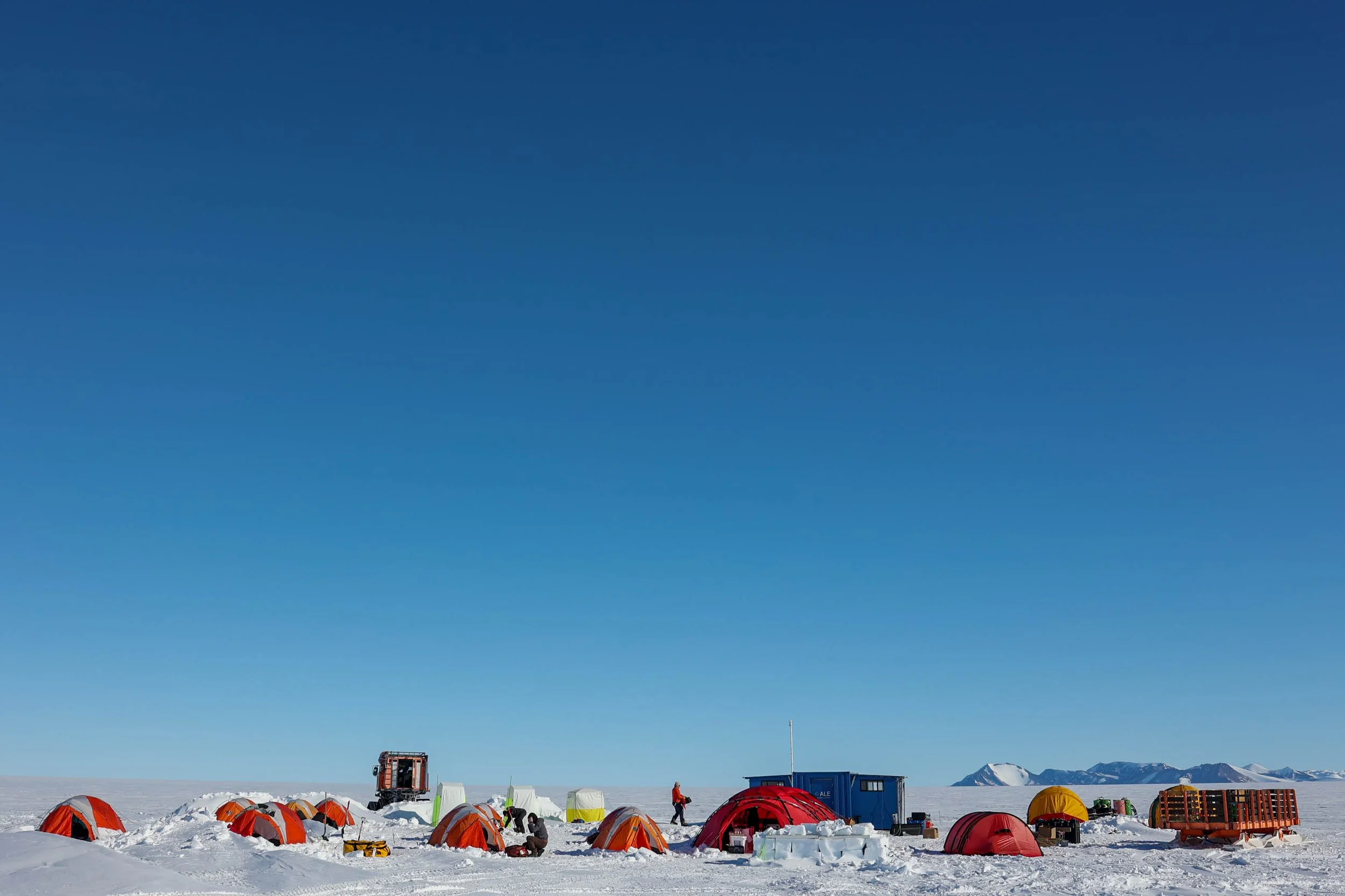
Living at the edges of your senses, in such an extreme environment, makes life’s simple joys more intense.
– Jerri Nielsen, Icebound
Constellation Inlet, Antarctica | - 79.5892 S, - 80.6711 W | Nov. 28th, 2025
For the second time in three days, I am boarding a plane for one of the best flights of my life, filming our team as we climb into a ski-equipped DHC-6 Twin Otter at Union Glacier. After rumbling down a snowy runway, the small plane lifts off, soars over the Ellsworth Mountains, and heads north to the Ronne Ice Shelf. I stare out the window for the entire 10-minute flight.
In contrast to the dramatic mountains surrounding Union Glacier, the ice shelf is a vast, flat expanse of white. Looking down at the massive tundra below us, I can just make out a long, single track path in the snow. Then I spot the Tucker Sno-Cat, loaded with all our gear, chugging along in the same direction.
A few minutes later, we get the first glimpse of our field camp — where we will live and work for the next two weeks. From a few thousand feet in the air, it appears as a tiny dot in the middle of nothing.
It feels as though we are flying to the literal edge of the earth.
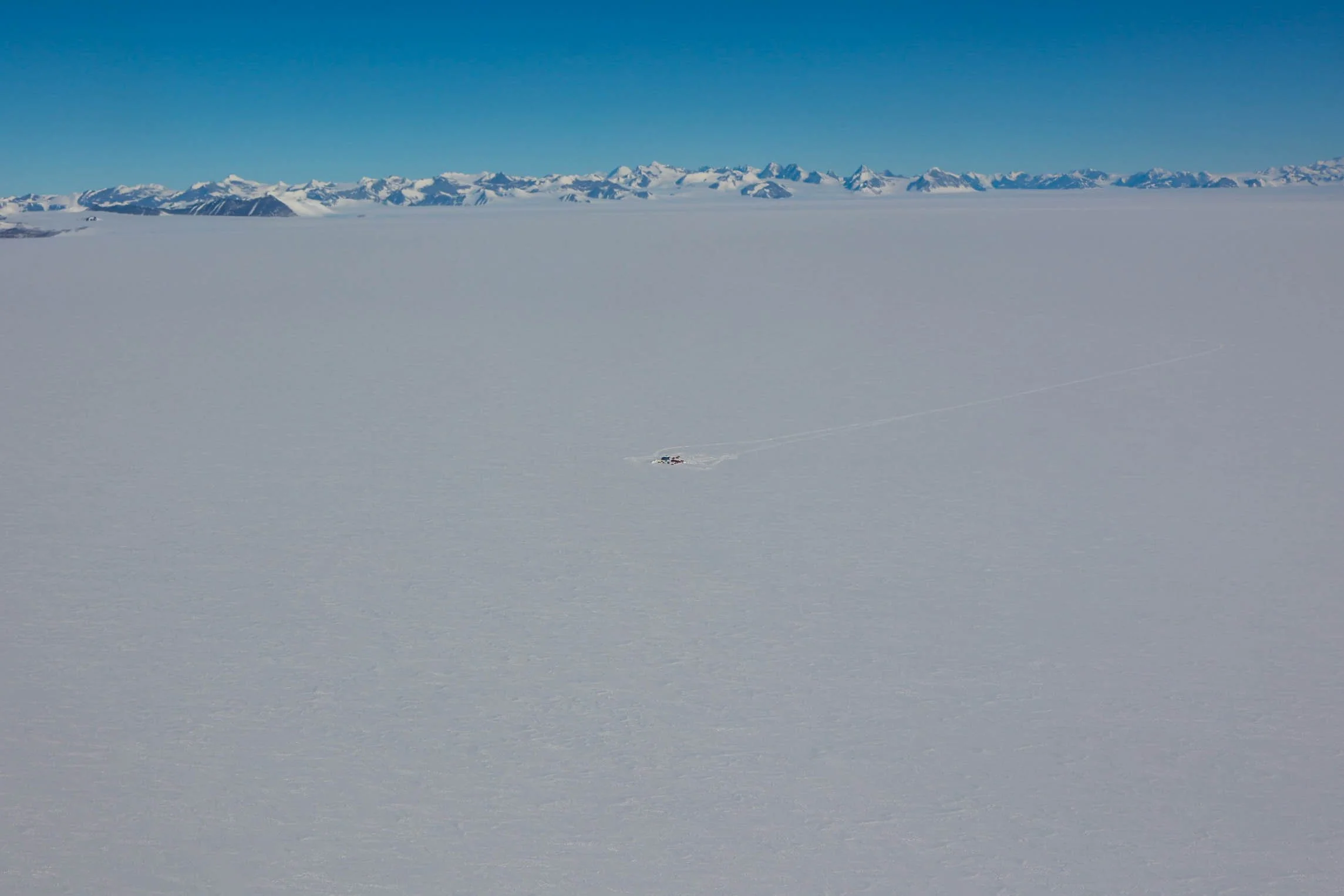
A blip in the Antarctic universe: from a few thousand feet up, our field camp is just barely visible.
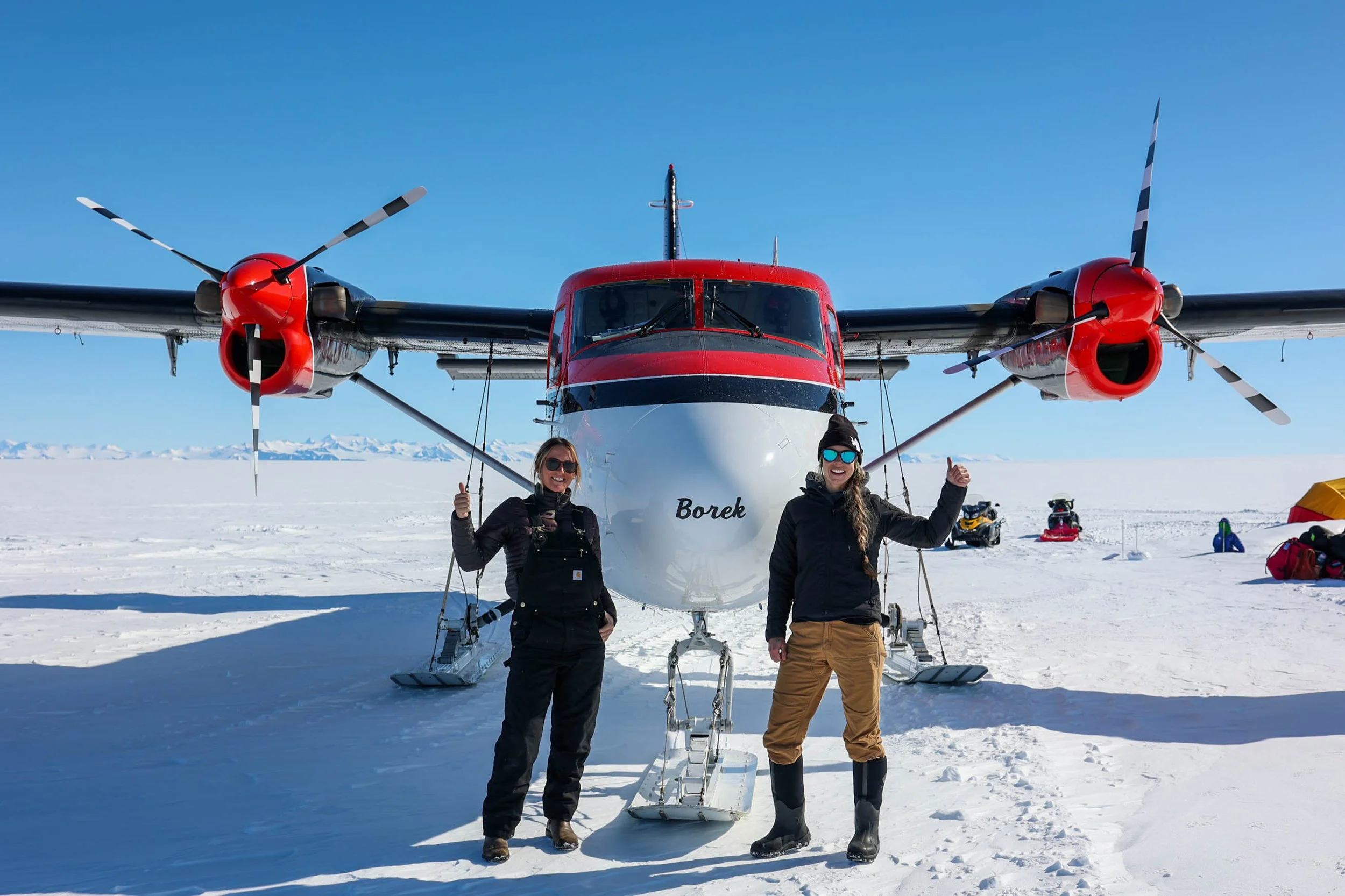
Let’s hear it for women in polar aviation: We are very grateful to ALE pilots Jenny Peterson and Heidi Bell for flying us out here.
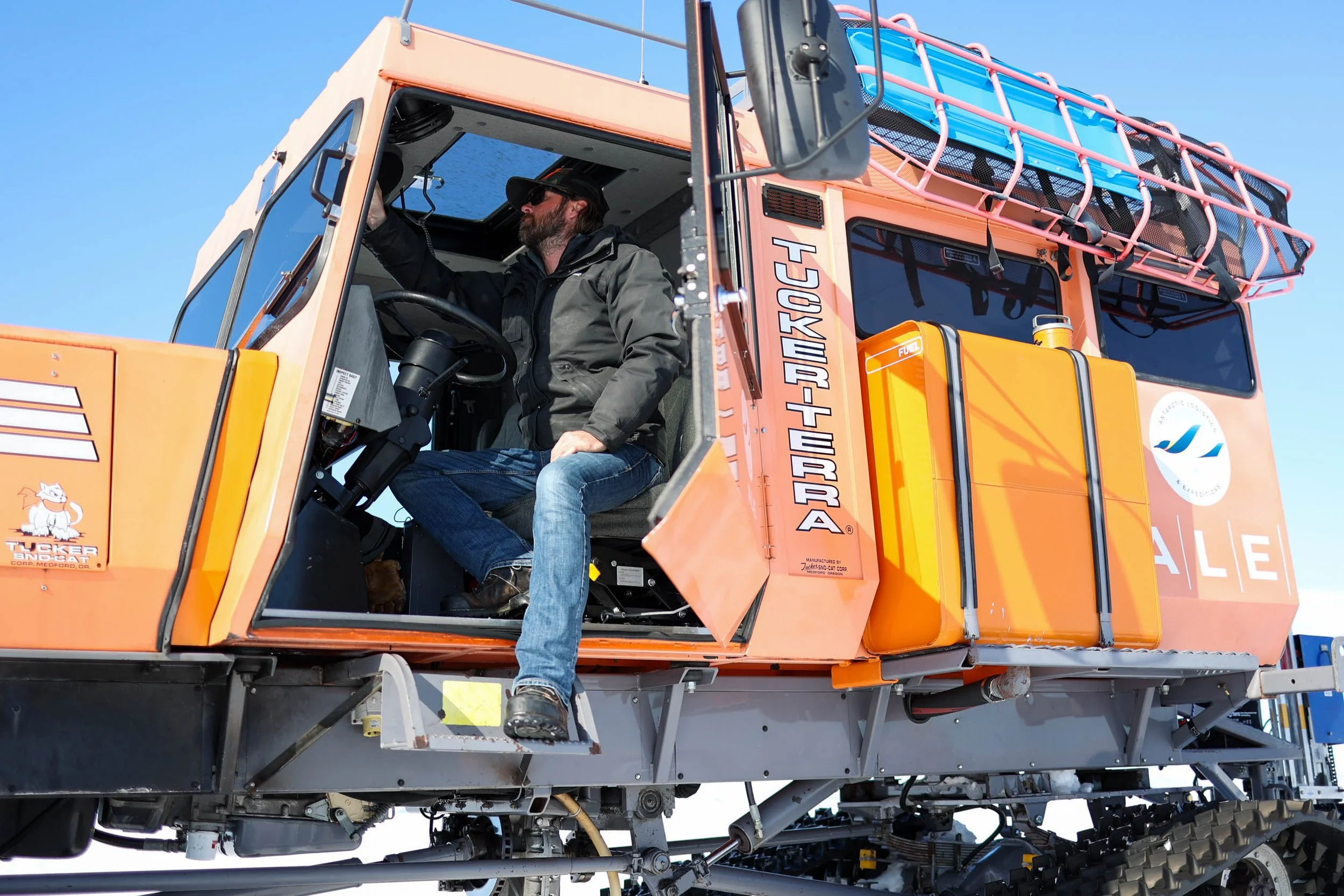
Special delivery: Josh Hoeschen drove a Tucker Sno-Cat 40 kilometers to bring all our equipment to the field camp.
When we clamber out of the plane, each of us stares around in disbelief. The blazing sun radiates warmth and everything seems to appear in high definition. Darren McAulay greets us with open arms. “Welcome to your field camp!”
I snap photos of a few members of our team in front of the plane, then ask the pilots (two young, tough women) if I can take a photo of them as well. Everyone comments on the impressive setup, eliciting smiles from Darren. Joel and I do celebratory handstands, feeling euphoric.
Our camp perfectly illustrates the expertise of Antarctic Logistics & Expeditions (ALE). In just eight hours, ten ALE staff members erected everything we see before us: 14 sleeping tents, a dining tent (three connected Hillberg Atlas domes), two bathroom tents, three storage tents, and a square metal structure called the Berg.
The Berg is especially impressive. Transported as the size of a shipping container, it expands into the shape of a small square building, with enough space for a dozen people to sit at tables and plug devices into its many outlets. The model name, Berg E2S2, is short for energy efficient shelter system. With solar panels hung on the exterior walls, the Berg can produce enough electricity for all of us to use our laptops and charge a rotating cast of batteries.
“Coming into this, we had some concerns about making repairs in a tent or keeping folks warm enough,” Andy Klesh says. “But all that evaporated when we saw we had this proper structure with power.”
Darren gives us a full tour of camp, starting with what is arguably the least appealing (but most important) area — the bathrooms. The same protocol we had at Union Glacier applies here.
“Over there is the poop tent – only solid human waste and toilet paper in that one,” he says, pointing to the tent on the far left. “Next to it is the pee tent. And then the third one there is a storage tent.”
Perhaps the most jaw-dropping experience comes when we walk into the dining tent. The space contains three tables, a dozen folding chairs, and buffet area where Pato has laid out a beautiful spread of cookies, chocolate, nuts, energy bars, coffee, and tea. He smiles shyly as we all exclaim with delight.
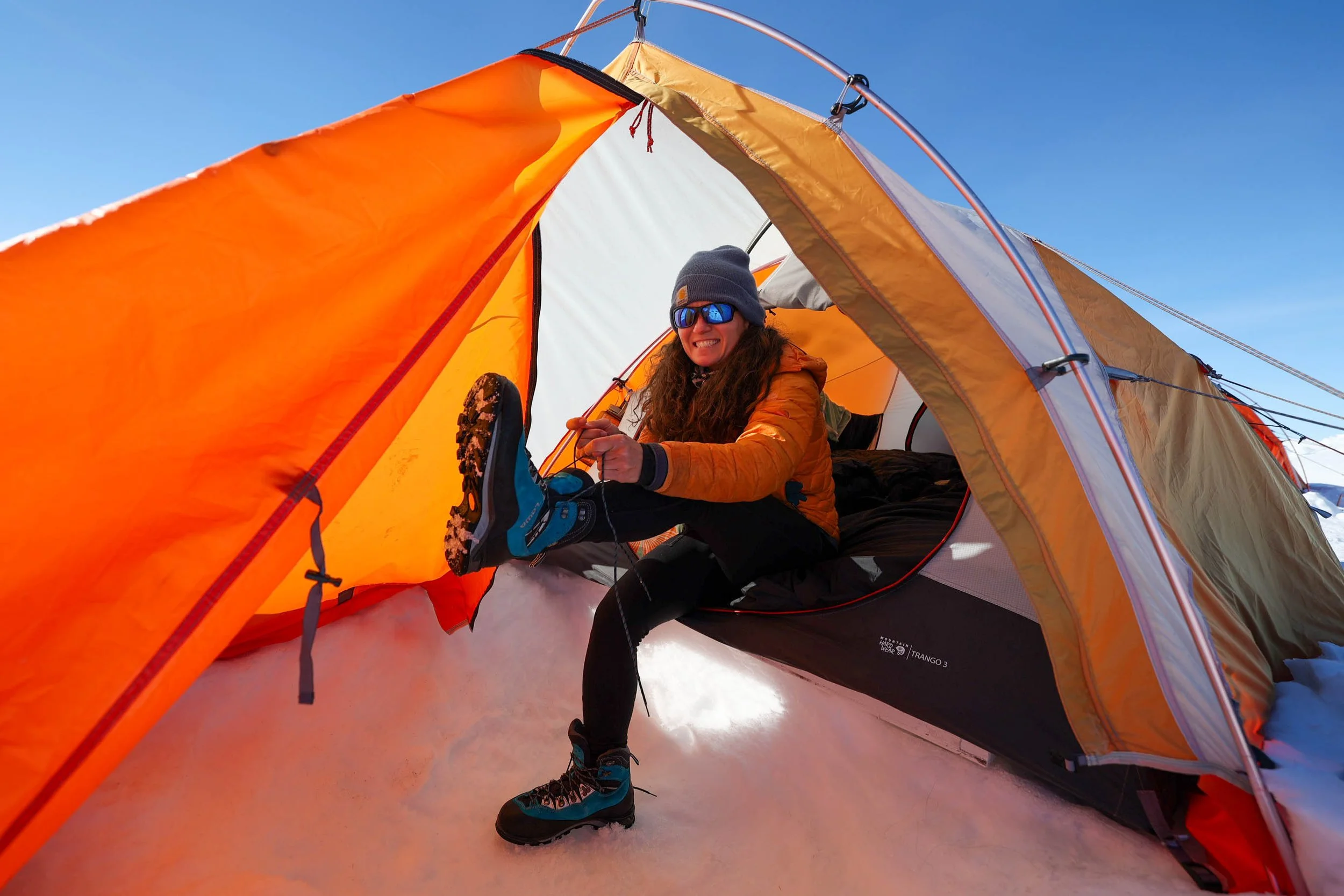
This is how we roll: Very grateful to the ALE guys for showing us this excellent snow camping hack.
After a round of snacks, Pat introduces us to our accommodations. We will be sharing tents, with two people in each. “There are a couple things you can do to maximize space,” Pat says. He goes on to explain how each Mountain Hardware Trango 3 tent comes equipped with multiple pockets for organizing accessories or hanging up clothes. ALE has also outfitted the tent floors with a layer of insulation and comfy sleeping pads. On top of that, we each have extra thick polar double sleeping bags.
Pat demonstrates how to dig out a “front porch” area to facilitate putting on our boots. To make the tent space less cramped, we can leave our weatherproof duffles outside — as long as they are zipped up and tied down.
I think all of us were nervous about the prospect of living in tents in one of the harshest environments on the planet. But as Pat, Darren, and Josh show us around and give us tips, our anxiety evaporates. We will be just fine here. Better than fine — this is going to be awesome.
We have come to this far-flung part of the planet to execute the field component of the Grounding Zone Long-Term Acoustic Sensing of Structure (GLASS) project. Over the next two weeks, our team will install five kilometers of fiber optic cable and several instruments to record high-resolution seismic measurements. Examining this location, where the ice sheet transitions from grounded ice to floating ice shelves, can help us better understand tidal effects on glaciers. Understanding the physics of glacial evolution is essential for producing more accurate models that can better inform the global discussion around climate change and sea level rise.
The next morning, we wake up to the sound of our tents flapping. When I unzip the tent fly, it looks like a blizzard — but it’s not snowing. The wind is blowing the existing snow sideways, creating new snowdrifts.
“The wind is what shapes the landscape here,” Josh says. “We’re gonna need to dig out the tents.”
Shoveling snow, I quickly learn, is an excellent workout. When I walk into the Berg half an hour later, my face is flushed and sweaty, even though my clothes are frosty. I strip off my icy beanie and frozen gloves. Josh shows me where to hang them up (near a vent blowing hot air) so that they’ll dry out. Meanwhile, Nick, Pat, Galen, and Andy are preparing to head out onto the ice. Today they will mark out the five kilometer line that will eventually include the fiber optic cable and a variety of instruments. The weather doesn’t stop them from getting right to work. I grab a spare beanie and a dry pair of gloves (feeling grateful I brought extras) and follow them out with my camera.
Over the next three days, the team works efficiently: bringing the DAS system online, deploying the fiber, building the towed GPR system, and putting out hundreds of lightweight seismic sensors that will help map the subsurface ice.
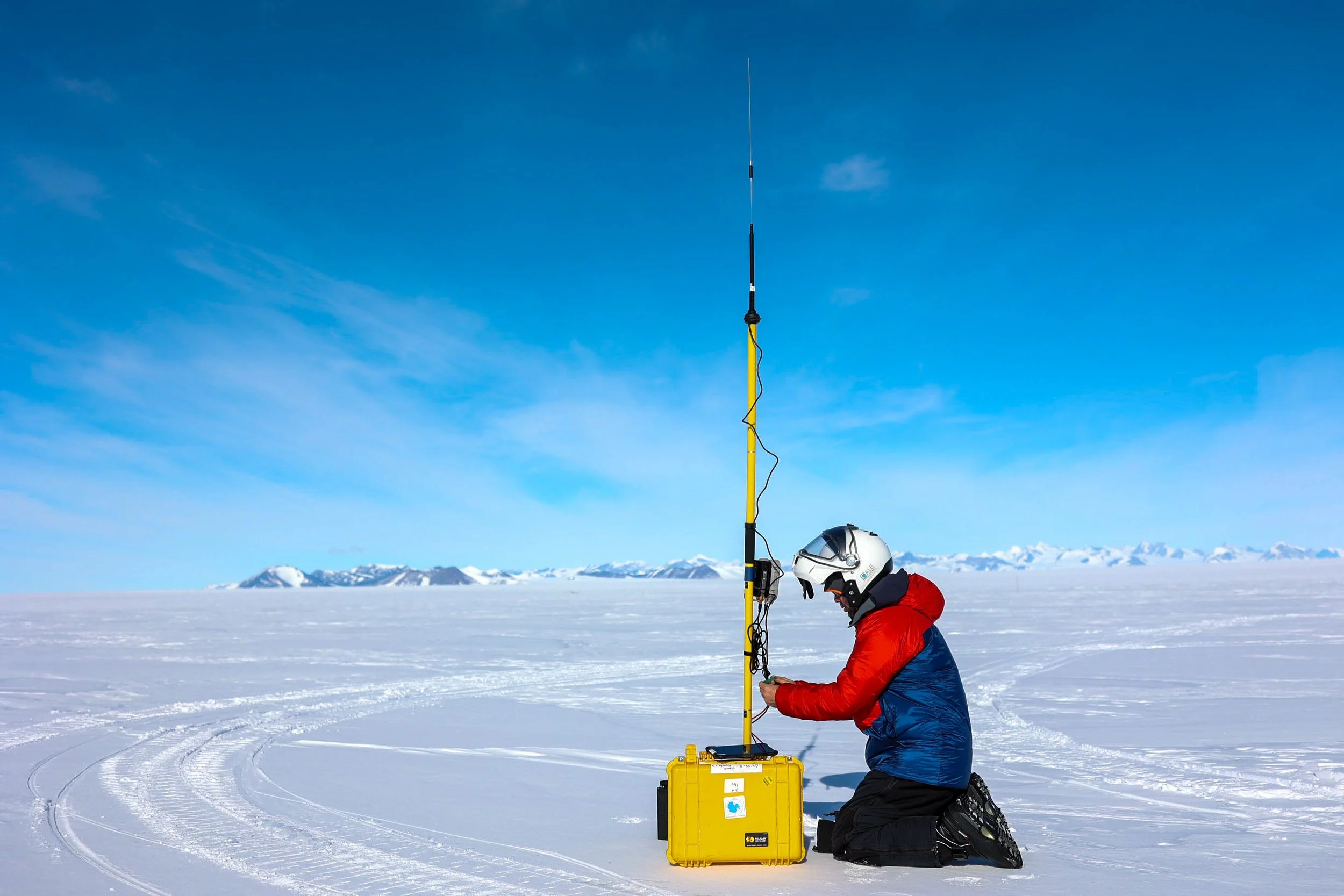
Astronaut vibes: Andy Klesh installs a GPS antenna along the route for the fiber-optic cable.
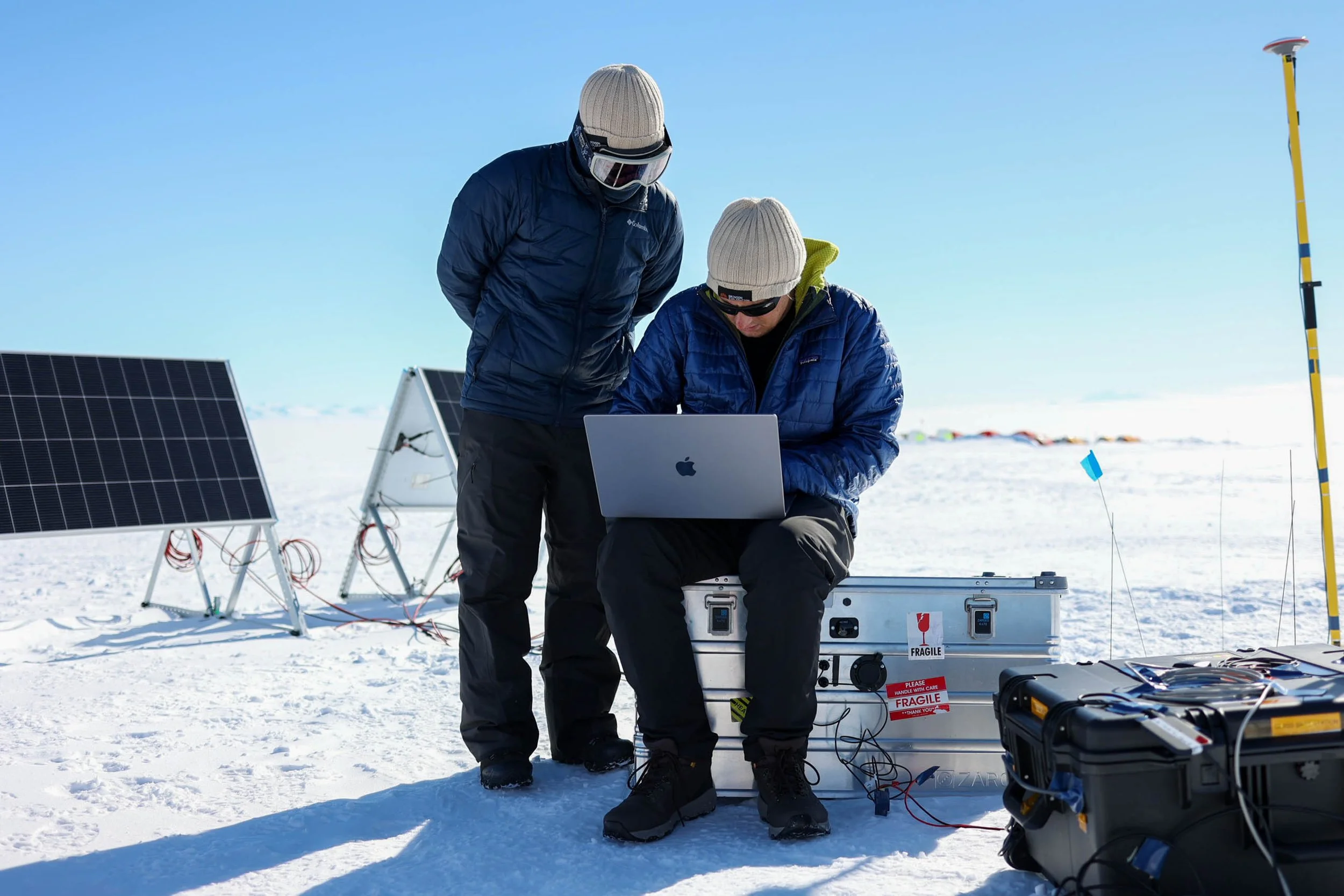
An office on the ice: Zhongwen Zhan and Gerik Kubiak review data coming in from the DAS.
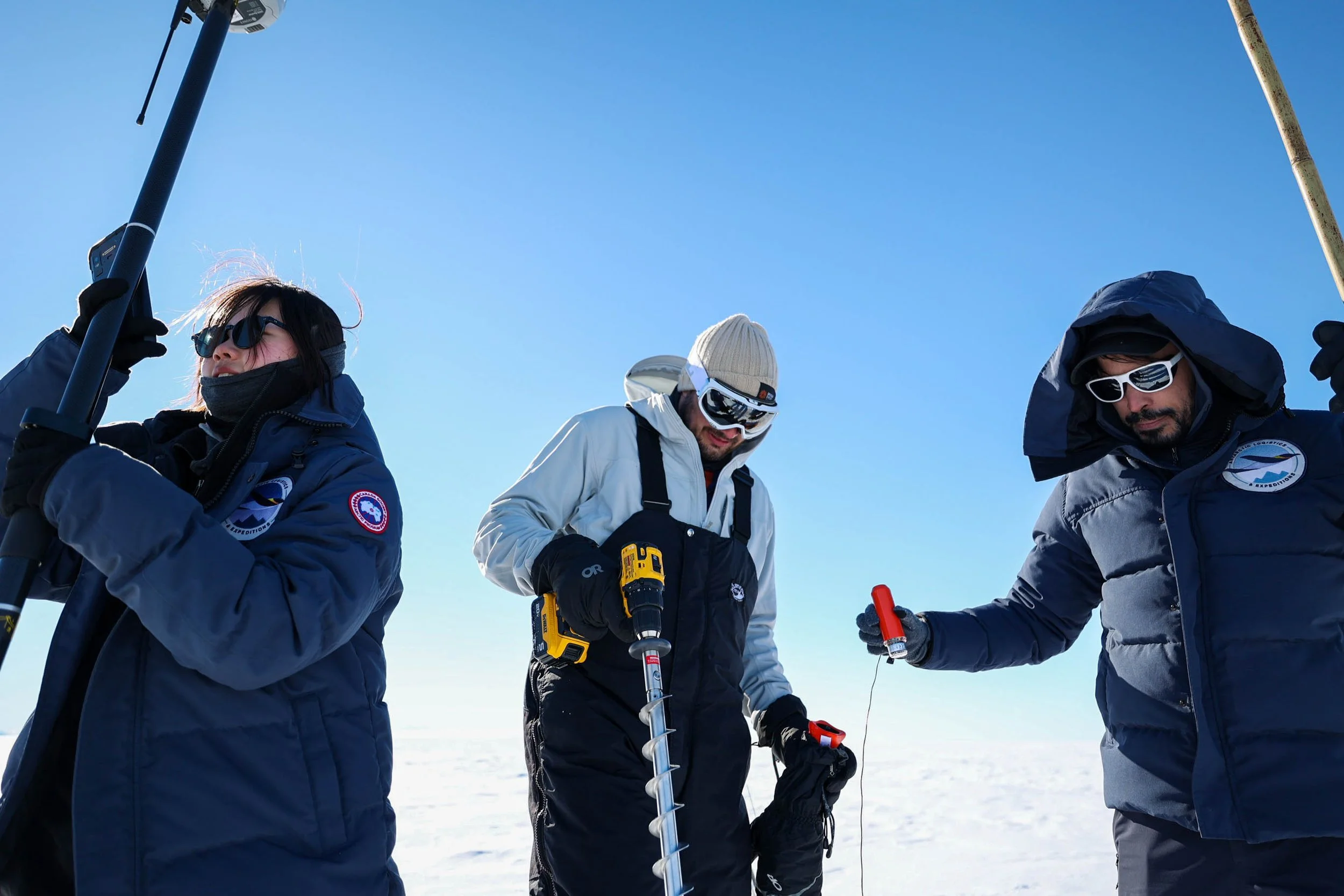
STRYDE Team Alpha in full effect: Soyeon Park, Chris Lefler, and Luis Costa finish deploying 500 nodes.
Living in a field camp in Antarctica is a first for everyone on our science team, but this extreme environment is familiar territory for our ALE guides. As we adapt to living in this wild place, Josh, Darren, and Pat patiently issue reminders about what we should and shouldn’t do around camp. Don’t forget to zip up your tents. Close the toilet lid. Use the damn hand sanitizer.
Blowing snow and 24-hour sun present unique challenges, but there are many aspects of camping in this environment that I love: no mosquitos (or bugs or critters of any kind) no rain, no mud, and no humidity. For several days in a row, we have incredible weather: no wind, blazing sun, and temps hovering around 13 or 14 degrees Fahrenheit. I never imagined that temperature range could be comfortable, but with no wind and abundant sunshine, it feels like the equivalent of a 65 degree day.
“The only cold things here are the snow and the wind,” Luis says. “If I shove my bare hands in the snow, I’ll be cold. If the wind blows, I’m cold. Otherwise…”
“…otherwise it’s a desert,” I say, completing his thought.
“You’re basically in a solar oven,” Darren says.
Applying sunscreen becomes as routine as drinking water: I put it on when I wake up, and again when I have my second cup of coffee, and again at lunch… I end up slathering my face with SPF 50 five or six times a day. I wear a buff and ball cap and still my skin feels hot and raw. When I look around the Berg (the only real “indoor” space we have out here) I see red cheeks and pink noses. Joel seems to have more and more freckles each day.
“There’s just no way around it,” Pat says, when I complain about the apparent ineffectiveness of my fancy sunscreen. “No matter how much sunscreen you put on, you’re still getting UV damage.”
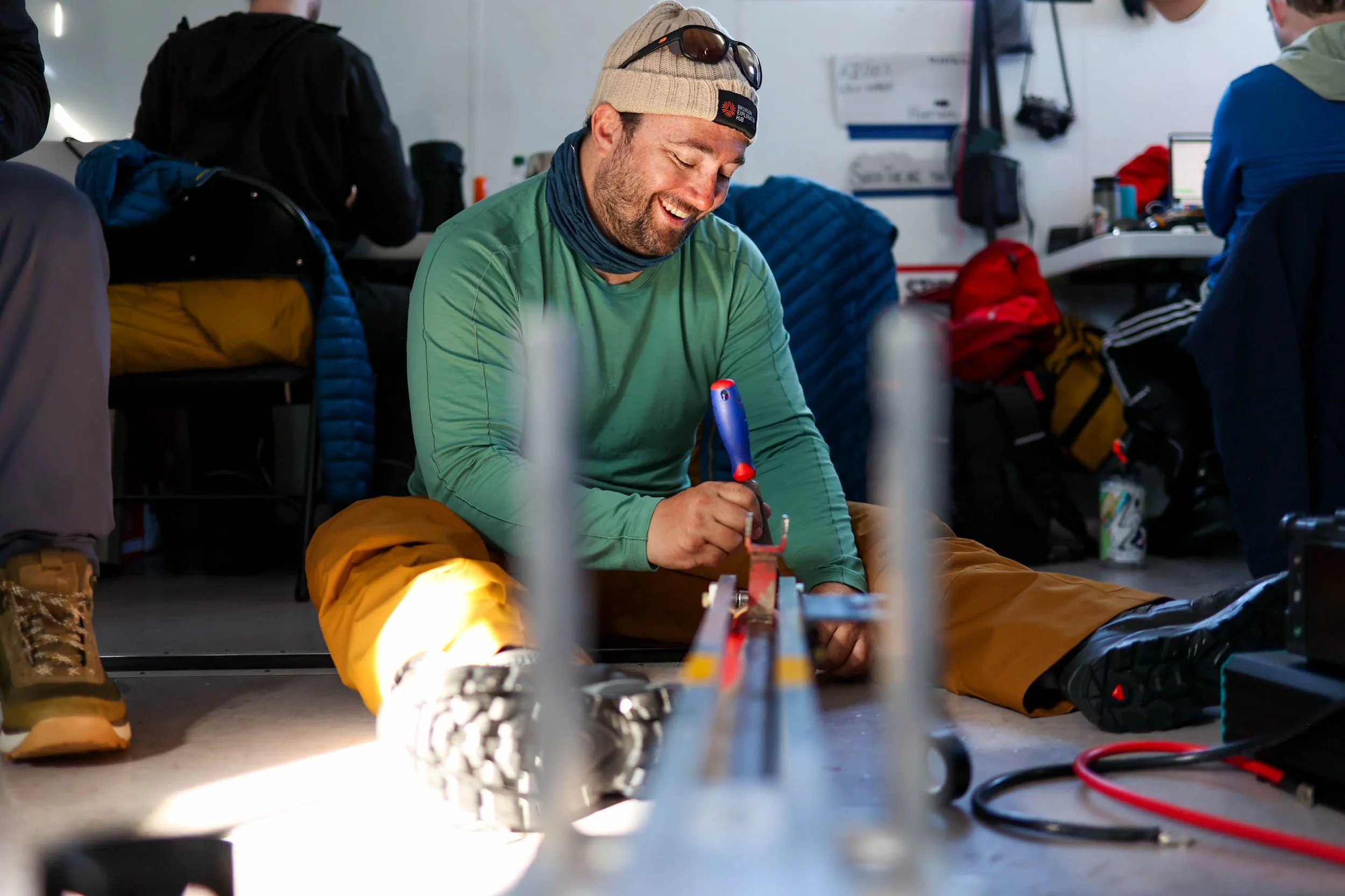
Make it work: Joel sits on the floor of the Berg, filing down sharp edges on the PEG.
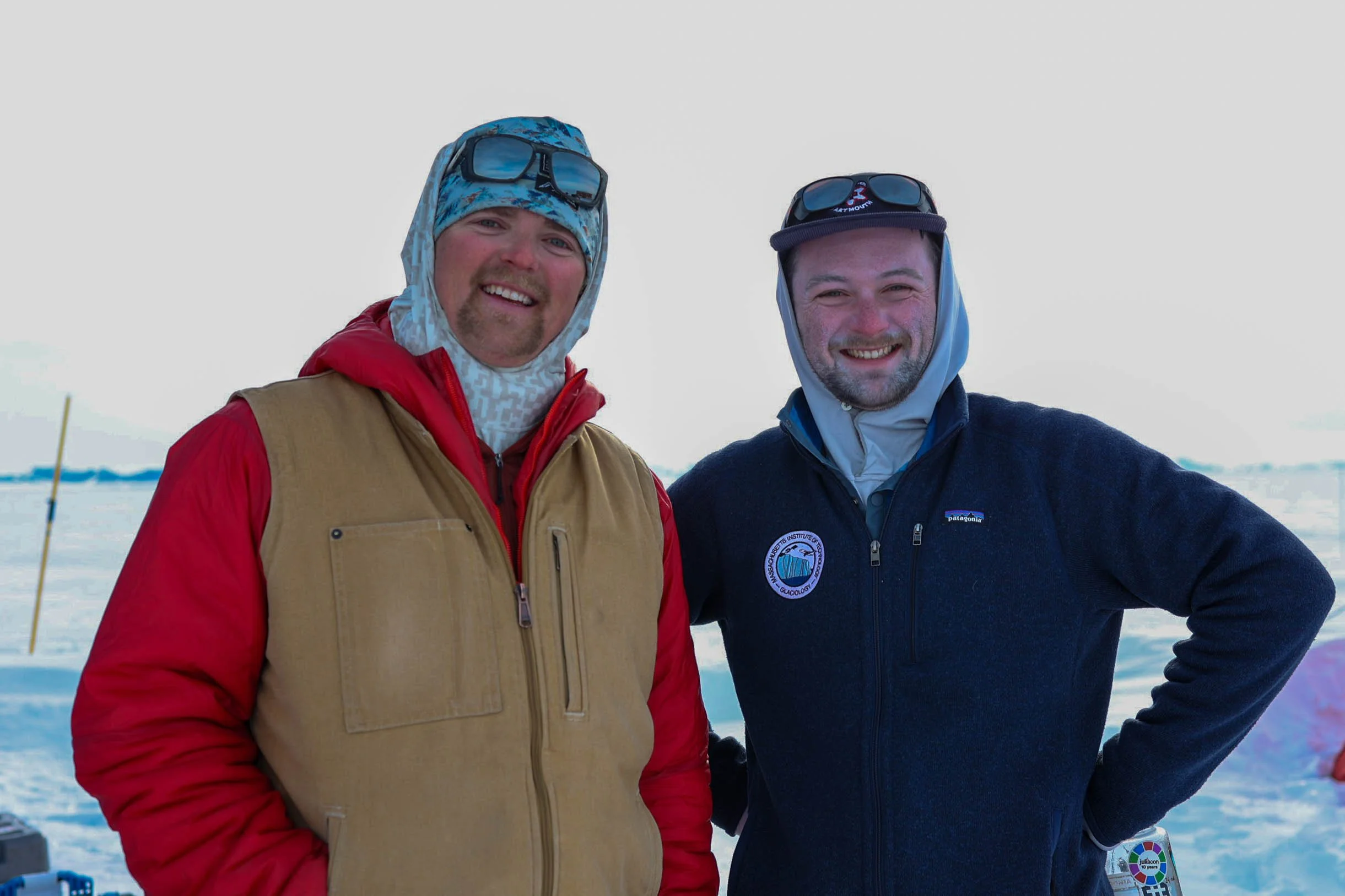
Twinning: Pat and Thatcher look like brothers, especially in their sun protection.
UV rays penetrate the fabric of our tents too. In the middle of the day, the tents bake and temperatures inside them can feel suffocating (sometimes reaching over 80 degrees Fahrenheit) but they keep us cozy when it comes time to sleep. While the outside air temperature often drops to 7 or 8 degrees in the late evening, the sun remains high in the sky. When I head to bed, I never wear more than a t-shirt and gym shorts to sleep in — yet I often wake up sweating in the extra thick sleeping bag. It’s disorienting each time I awaken in the middle of the “night”. With the tent illuminated like a light box, my brain assumes it must be morning, but then I fumble to look at my phone and see it’s 2:30am. Exhaustion is a hell of a sleeping drug though. I roll over, adjust my eye mask, and immediately pass out again.
I know from previous expedition experience that establishing (and maintaining) a daily rhythm is helpful. Out here, I fall into a natural routine of going to sleep around midnight and waking up around 6am. Pato serves breakfast promptly at 8am each morning, which means most folks begin emerging from their tents around 7:15 or 7:30. Waking up at 6am allows me to have about an hour of blissfully quiet time to myself. Each morning, as soon as I exit the tent, I turn in a slow circle, gazing at the white expanse spreading north and the distant mountains in the southwest. Savoring the stunning view, coupled with the calm stillness of the morning, is an incredible way to start the day.
It’s just after 7am when I walk into the dining tent. As usual, Pato is busy behind the stove, cooking up eggs, sausages, pancakes, and oatmeal. He has already prepped a large dispenser of boiling hot water (so that we can easily make coffee and tea) and laid out a beautiful spread of fresh fruit. Each piece of fruit is cut at a precise angle and arranged delicately on a platter. It looks like the sort of thing you would see on a breakfast buffet at a five-star resort. The sound of sizzling oil and the aroma of savory, hot food only adds to the presentation.
“Pato,” I say, “this is so beautiful!”
He smiles. “I like to make it look nice — I think it adds to the experience. My mother would say cocinar con cariño — cook with love and care.”
There are so many things about living in a field camp at the edge of the earth that we couldn’t have predicted or expected. Pato’s cooking (and his soulful spirit) might be the most pleasant of the surprises.
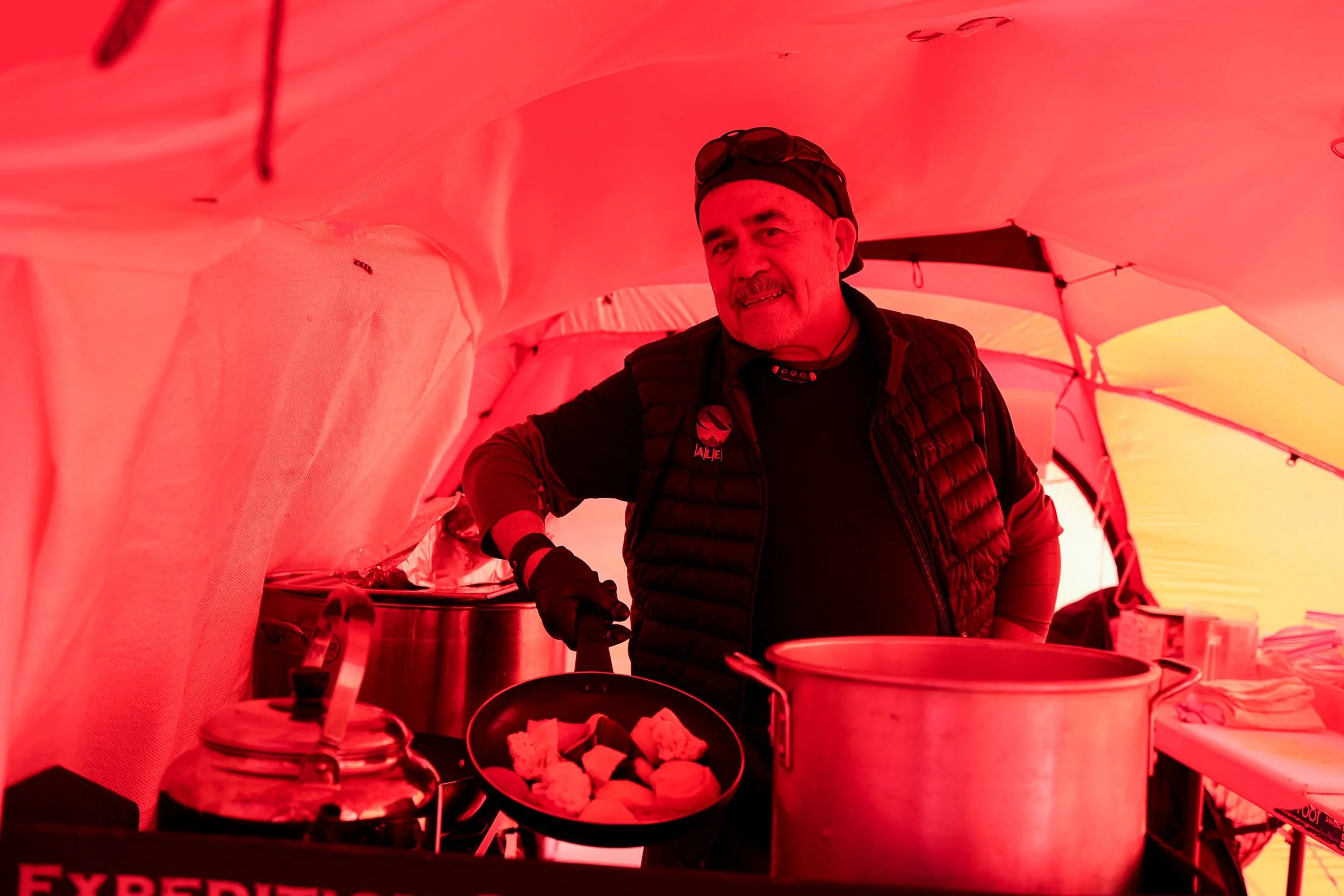
Cocinar con cariño: Pato Gonzalez puts his heart and soul into every meal he prepares. And we are very, very grateful.
As we approach the final days at camp, some of us start to discuss plans for returning to UG and then starting the long journey home.
“You know, typically I would be thinking about all the things I can’t wait to have,”‘Chris says. “Like I might think I can’t wait to eat a good, hot meal again… except the food here has been excellent. Or I can’t wait to be warm again… but I haven’t really felt cold. I would normally miss my bed but the sleeping situation in the tent is really comfy.”
We know Chris has been comfy and sleeping soundly because we’ve listened to his deep rumbling snores (which reverberate through the entire camp) every night that we’ve been here. The team has made multiple comments about how we don’t need an instrument like the PEG (Propelled Energy Generator) to generate an acoustic signal in the ice — a slumbering Chris Lefler would be plenty.
“It’s going to be kinda weird to leave here,” Thatcher says.
I nod, thinking of the many times I’ve felt at home on a ship. “It’s always weird,” I say, “Your entire world shrinks down to this particular space and this specific group of people — and then suddenly it evaporates.”
In just a few days, we will load into the Twin Otter planes again to return to Union Glacier. As soon as we depart, the ALE team will pack up the entire camp — when they finish breaking everything down, it will look like we were never here.
But I don’t think any of us will forget the time we spent living and working in this remarkable place.
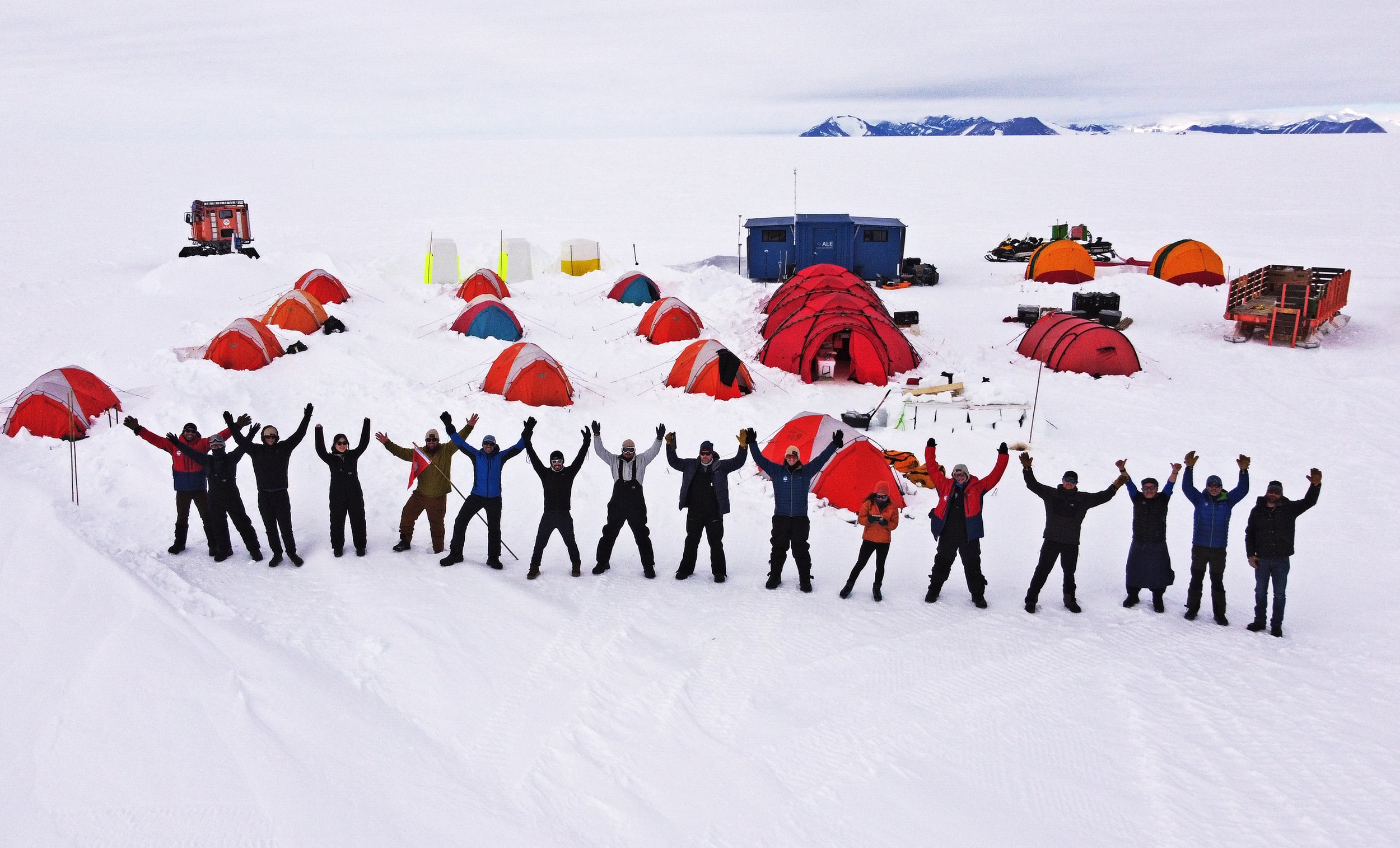
A tiny society at the bottom of the world: Cozy accommodations. Solid camaraderie. A lot of good vibes.
Want to check out more stories from our time in Antarctica? Read about how our journey began here: On the Ice | Part One: Efficiency and On the Ice | Part Two: Delight
Read more about life at our field camp here: On the Ice | Part Four: Mindset
Learn more about our instruments, equipment, and data collection here: GLASS Project | Antarctica Field Notes