
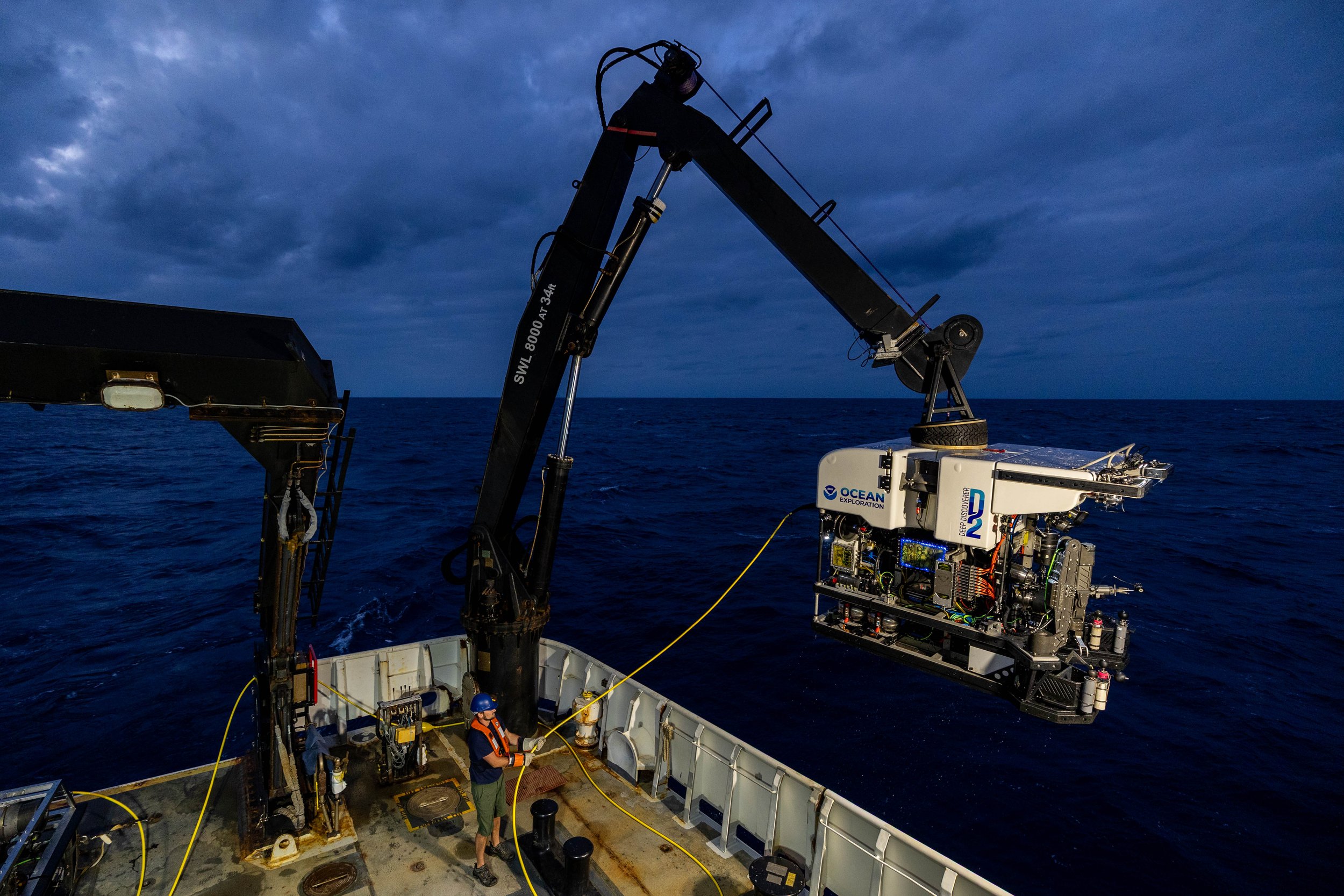
South Pacific Ocean | 21.23° S, 159.78° W | Aug. 10th, 2026
When we send the ROVs down to the seafloor 99% of the things we see, even on an individual level, are never going to be seen again.
This is the only time people will see this meter-by-meter portion of the earth.
— Chris Ritter, Remotely Operated Vehicle Team Lead
When I step into the hallway, I squint at the abrasive fluorescent lights and close the door gently to avoid waking my roommates. It’s just after 6am. I walk into the dry lab, grab my camera, and turn around to head out the watertight port side door. A punch of salty South Pacific air blasts my face. While the temperature is warm, days here in the southern hemisphere are shorter at this time of year — the sun won’t rise until after 7am. Through a gap in the clouds, I spot a few twinkling stars.
I wrench open another watertight door, walk down a short staircase, and enter the hangar where the ROV team is already hard at work. Music blares from a Bluetooth speaker as multiple people circle around Deep Discover (D2) and Seirios. Despite the early morning hour, each person is focused and methodical in their movements. Running through checklists. Asking questions. Making visual and verbal confirmations. They ensure the correct valves are closed, check that all science equipment is in place, and examine every inch of the deep sea vehicles for leaks or any other potential issues.
Once the high voltage power comes on, the team turns their attention to the thrusters, ensuring D2 can maneuver safely in the water. “We check for thrust commands, and then we check everything that has a feed coming out of it – lights, camera, data, thrusters, hydraulics,” says Chris Ritter, the ROV Team Lead.
When the final checks are complete, Ritter radios the bridge to inform them they are ready for launch.
Fifteen minutes later, everyone takes their places for a choreographed sequence of movements on the aft deck. The deck team, wearing hard hats, gloves, and work vests, hold their lines on D2. On the boat deck above, Ritter stands next to Bosun James Scott who is in control of the crane. Meanwhile the captain and another ship officer oversee the ship’s dynamic positioning. Out of sight but just as essential are the pilots in the control room.
Ritter’s voice comes over the radio. “Alright, let’s launch D2.”
Scott shouts loud and clear, “Coming up!”
Like clockwork, the five-ton ROV rises smoothly into the air and moves towards the port side of the ship. The moment D2 goes over the railing and lands in the water is one of the most critical — and potentially the most hazardous. A wave could smash the ROV into the side of the ship. Tension on the tether (still on deck) could knock someone overboard.
“At that moment, I’m not worried about anything on the vehicle except thrust ability,” Ritter tells me later. “Once D2 is away from the ship, we can take a breath.”
As usual, the team executes the deployment smoothly. D2 bobs on the surface directly aft of the ship, as Seirios slowly descends from the A-frame. With both vehicles safely in the water, it’s time to go to depth. As they descend, the team in the control room will monitor the ROVs closely, looking for ground faults (indicators of a short or a leak). Once D2 and Seirios pass below 50 meters and all systems are working as they should, the dive is officially a go.
Throughout the morning, I take photos, film a few action shots, and try to stay out of the way. After years of documenting ROV teams on multiple research vessels, I’ve seen these scenes play out before. The pre-dive checks in the hangar, the launch sequence on deck, and the rapt attention in the blue glow of the control room — it’s all familiar.
But I still feel a degree of disbelief. This team may make it look easy, but sending specialized robots over 5,000 meters deep to the seafloor is no small feat.
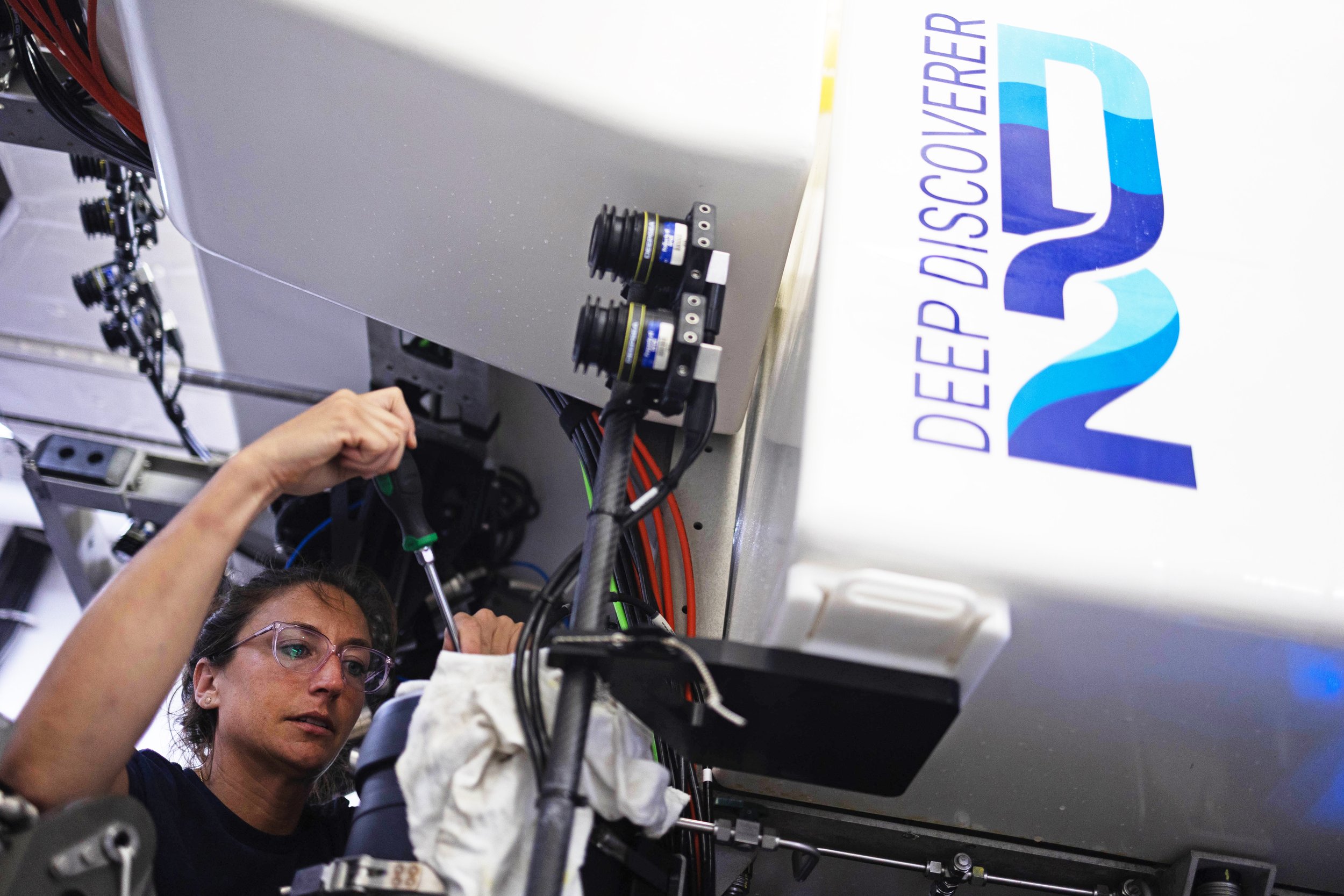
Hands on: Sarah Haberstroh releases air from an oil compensator. The rag helps to soak up any oil that comes out.
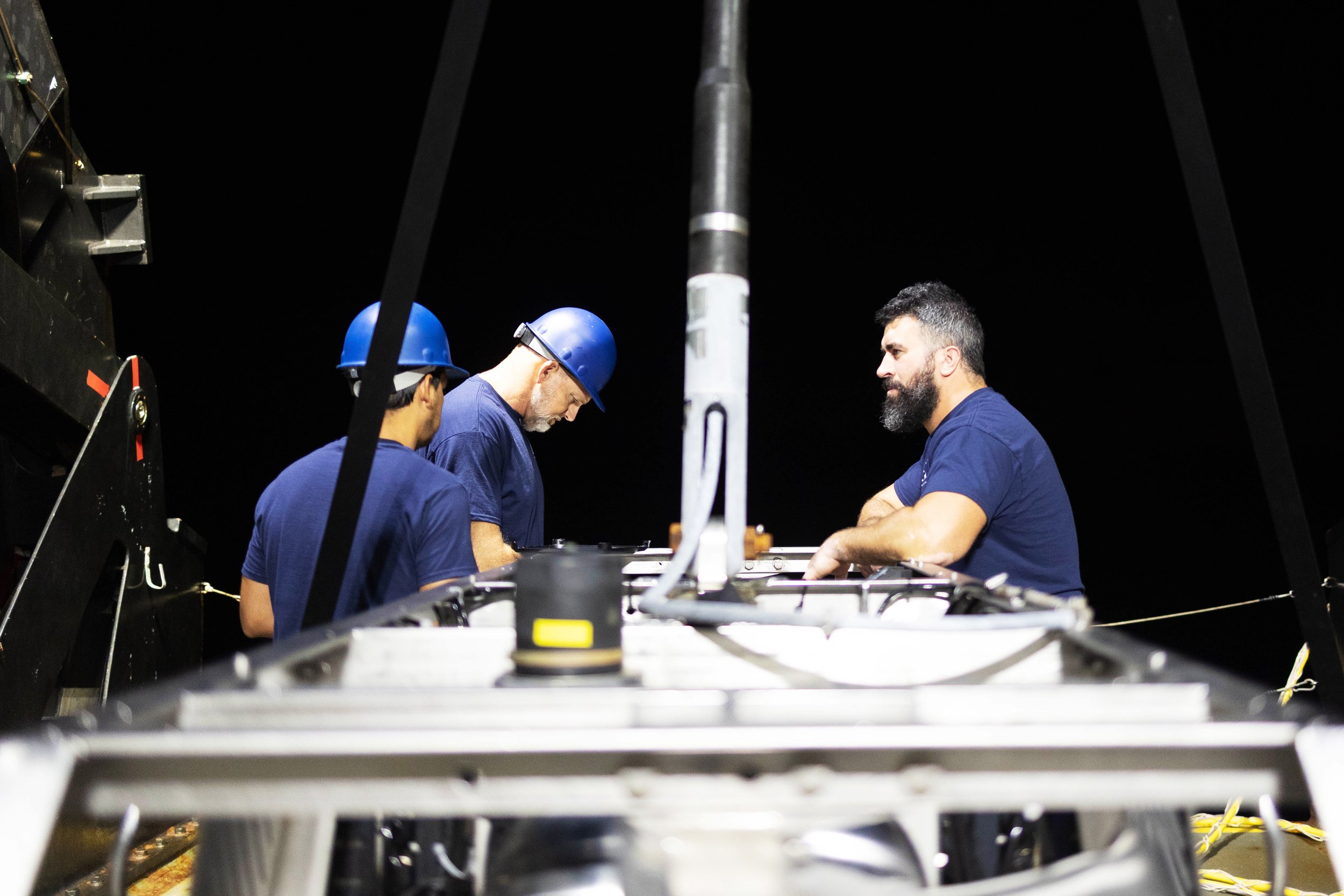
Pre-dive checks: Fernando Aragon, Bret Whitman, and Sean Kennison run through the pre-dive checklist on Seirios.
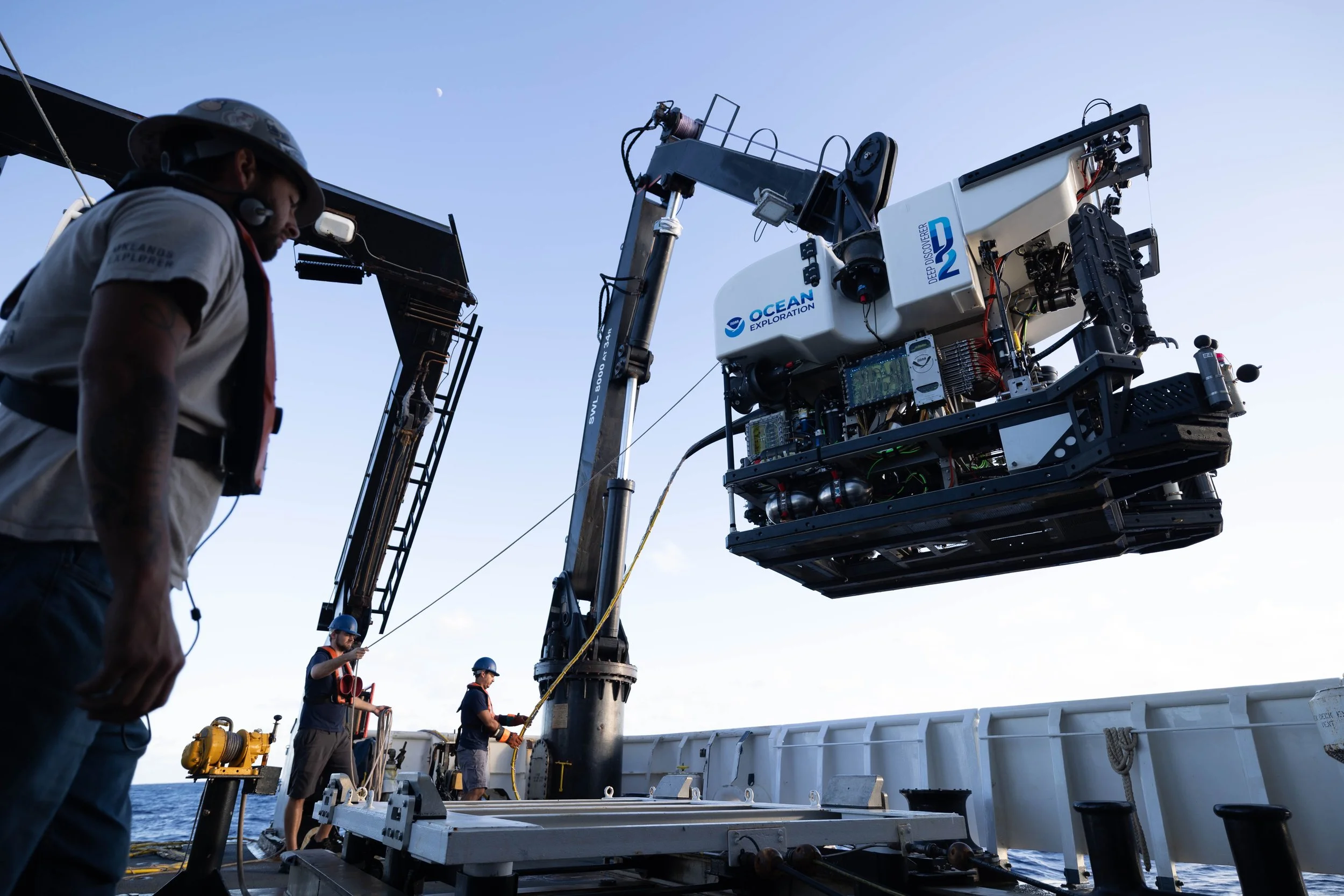
Let’s launch D2: Safely launching both ROVs requires a highly coordinated effort between the deck, the control room, the dive supervisor, and the ship crew.
For those of us who regularly participate in deep sea expeditions, extreme endeavors often start to feel routine. When ROV dives happen like clockwork, we don’t always contemplate the number of variables that play into our operations. The reality is that multiple complex systems have to sync up perfectly for us to be able to explore the bottom of the ocean.
First, there is the ship itself. Its dynamic positioning system, propulsion, sonar, communications, winch and other essential systems must be in good working order. Then, the people. All critical team members, in particular the crew members driving the ship, the deck team, and the ROV pilots, need to be healthy, rested, and ready to go. And of course we have to contend with the weather and the sea state — easily the most volatile and unpredictable factors.
What are no-dive issues?
Even if we’re all-systems-go on the ship, a dive could be scrubbed at the last minute due to:
Issue with thrusters
Issue with main video feeds
Issue with fiber
Issue with navigation and positioning sensors
Major leak
Anything on the diagnostic side that provides info on health of the systems
If the vessel, team members, and conditions are solid, we still have to ensure the ROVs are ready to launch — hence the methodical and systematic nature of the pre-dive checks. Sometimes a dive can be called off just before the vehicles are set to enter the water.
But when everything lines up just right, the outcome is spectacular. We get a front row seat to one of the best shows on the planet — the enigmatic and enchanting seafloor.
“No two ROV dives are ever the same,” Ritter says. “Most of the time, 99% of the things we see, even on an individual level, are never going to be seen again. This is the only time people will see this meter-by-meter portion of the earth.”
Chris Ritter first sailed on the Okeanos Explorer on the Cayman Rise Expedition in 2011. At the time, Ritter was a recent graduate of Virginia Tech (where he studied Naval architecture and ocean engineering) and he quickly noticed many of the principles he learned in school were directly applicable to working on ROV systems. He loved every bit of it.
“I like working with my hands, seeing the ingenuity of the two-body system, applying the engineering principles, and being part of a solid team,” he says. “It’s a good mix of adventure and hard work and problem-solving.”
Over a decade later, Ritter has accumulated a deep well of knowledge and expertise in every component of D2. But ensuring the ROV is functioning correctly is only half the job — the other half involves training and managing a small, industrious team.
“I really enjoy the leadership aspect,” Ritter says. “You give people the tools, empower them, and then step back and see what they can do. I love when things starts to click for new members of the team.”
On this particular expedition, the ROV team includes two new members, Michael Dennin and Sarah Haberstroh.
Being “new” to a position can mean a lot of things in the world of ocean exploration. When I ask Dennin how long he’s been working with ROV systems, I expect him to say a year or two.
“I literally just started,” he says. “I got on this boat for the first time in June.”
I have so many questions. How did you find out about this niche job? How did you get a spot on the ship? Did you train before you got here? How do you just suddenly become an ROV pilot?
But I start with a simple one: Why? What drew you to this work?
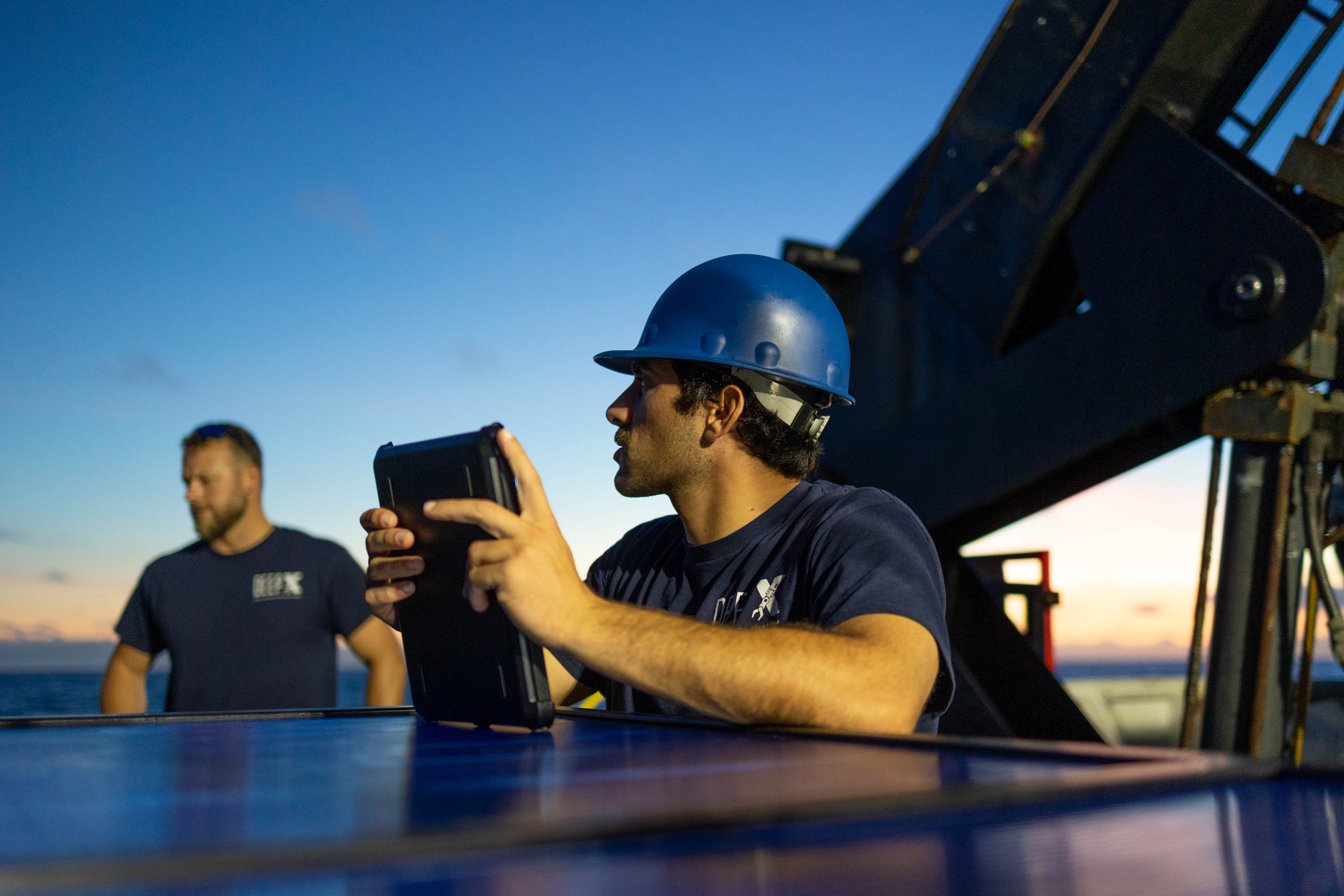
Methodical and systematic: After finishing the post-dive checklist on Seirios, Michael Dennin listens to his shipmates debrief on the back deck.
“It’s one of the few jobs where you get to be involved in every step of the process — working on the vehicle with your hands, designing, reconfiguring and troubleshooting,” Dennin says. “But on the other end of the spectrum you get to pilot it too. You do all the engineering work and then you actually get to enjoy how that work pays off.”
In addition to diving into the world of ROV ops, Dennin shares with me that this is his first time working at sea.
“Every part of this experience is new to me. Sleeping in a bunk, eating in the mess, doing a balancing act as I walk down the hall,” he says. “And then there’s this super complex engineering system that I have to familiarize myself with as quickly as possible. Every moment of the day I’m learning and training.”
But you wouldn’t know it. Dennin is a natural out here — an attentive ROV pilot, a reliable team member, and an easygoing, thoughtful shipmate.
By the Numbers
Every deep sea ROV is unique. Below are some of the vehicles I’ve documented during my career:
ROV D2 (NOAA Ocean Exploration Cooperative Institute)
Weight: 9,700 lbs
Max Depth rating: 6,000 meters (3.73 miles)
In operation since: 2013
ROV SuBastian (Schmidt Ocean Institute)
Weight: 7,055 lbs
Max Depth rating: 4,500 meters (14,764 feet)
In operation since: 2016
This is yet another component of ROV work that I find fascinating — the unique blend of attributes exhibited by a solid pilot. When I chat with Ritter, we dig into this topic. What makes someone a good pilot? What elements are most essential for their mentality and work ethic?
“Not getting flustered is huge,” he says. “But a willingness to try stuff is also key.”
Ritter tells me about when he was first learning to fly ROVs years ago, and how it felt difficult to get a handle on the speed of the vehicle. One of the veteran ROV pilots asked for a quick pause in science operations so that he could teach for a minute.
“I was flying little Herc and he told me to punch it ahead as fast as I could,” Ritter says. “So I went full throttle — and I immediately knew the limit.”
ROV Hercules (Ocean Exploration Trust)
Weight: 5,500 lbs
Max Depth rating: 4,000 meters (13,100 feet)
In operation since: 2003
ROV Jason (Woods Hole Oceanographic Institution)
Weight: 11,000 lbs
Max Depth rating: 6,500 meters
In operation (third generation) since: 2016
That simple action taught him a fundamental lesson about ROV piloting: you should push the boundaries, but know the limits. That mentality applies to both the vehicles and the people operating them. Piloting requires an immense amount of focus and multi-tasking — you have to be willing to push yourself, without taking it too far. In addition to running checks on all the systems, each pilot must monitor their own fatigue level. To combat the inevitable burnout, members of the ROV team regularly rotate in and out of the control room to give each other breaks.
“You have to be ale to recognize when your brain space is not correct,” Ritter says. “If you don’t, it’s going to be terrible.”
On extended dives and back-to-back expeditions, Ritter is adamant about protecting his team’s level of rest and giving them time to decompress.
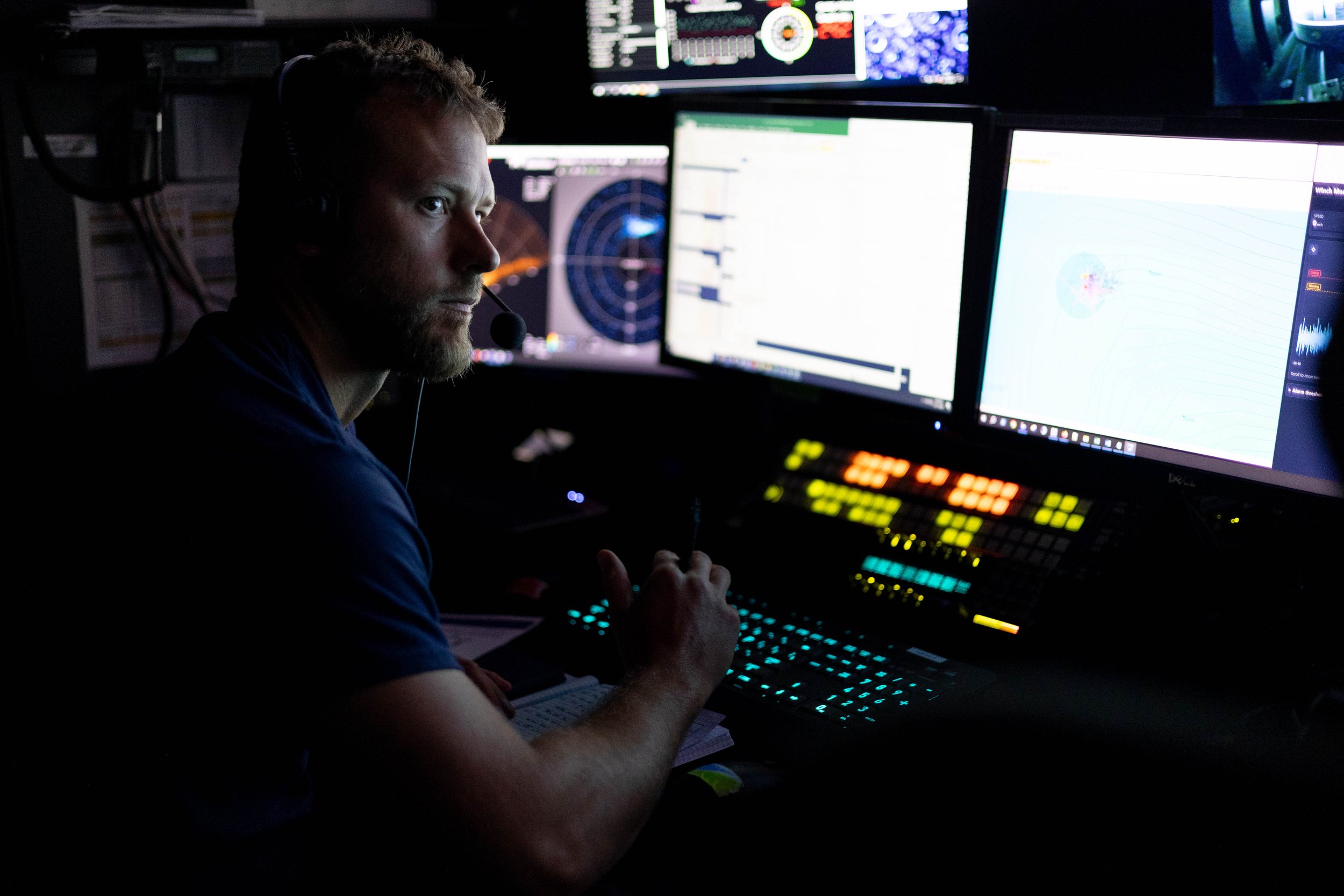
A good leader: Chris Ritter ensures both ROVs and each member of his team are well cared for and ready to work.
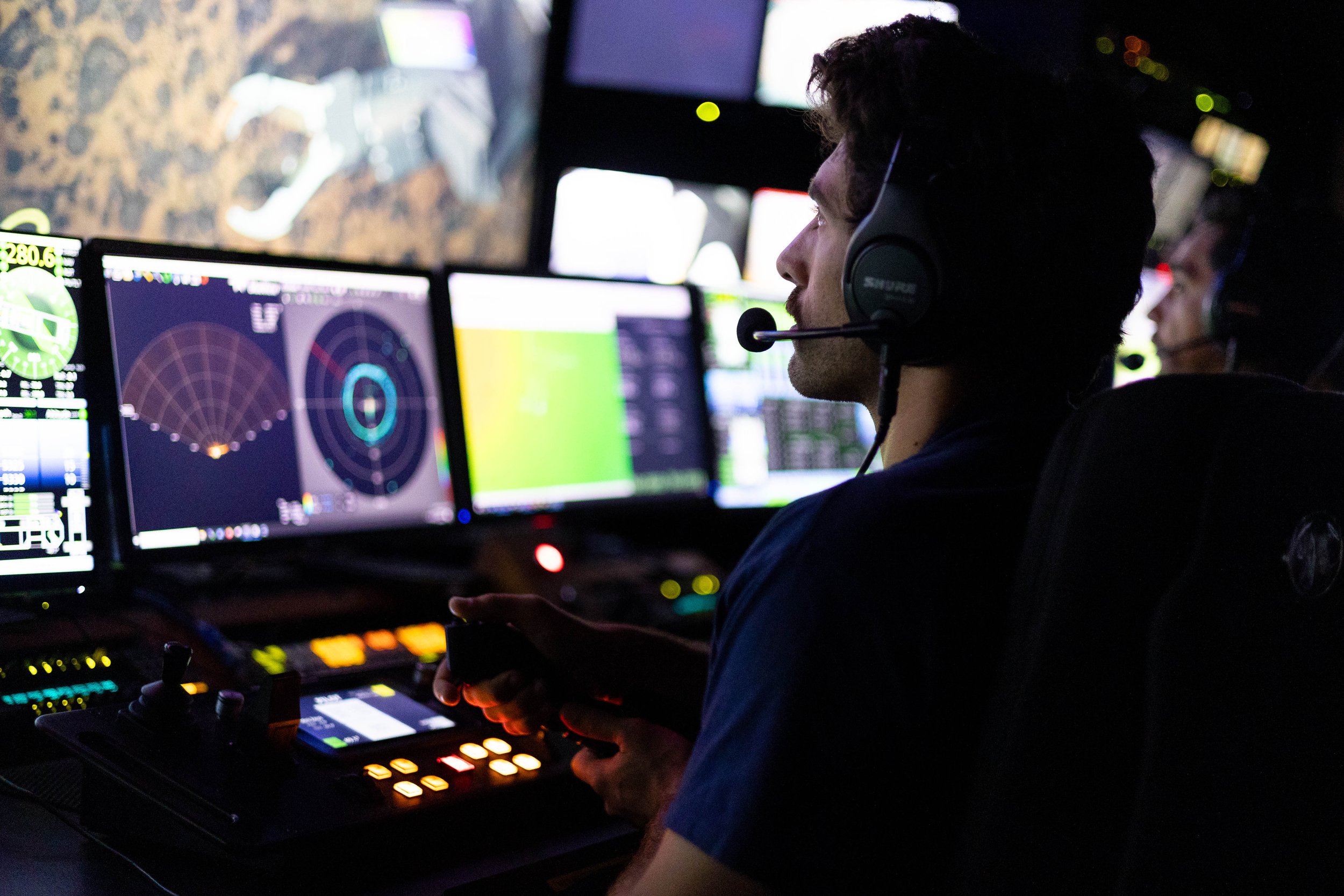
The rookie is a natural: Michael Dennin manipulates the Kraft arm from the control room aboard Okeanos Explorer.
“We can all be a bit stubborn I think,” Dennin says. “You want to do the best you can, but sometimes you have to listen to the voice that says it’s okay to hang it up for now.”
Dennin tells me about how becoming a pilot requires vulnerability, humility, and patience. Acquiring this highly specialized skillset does not happen overnight; it’s process that includes a lot of trial and error.
“You have to put yourself out there enough to make mistakes and learn from them,” he says. “At this point, every time I sit in that chair, there’s something that’s making me nervous — but I see that as a good thing. Those nerves help me focus.”
This perspective is yet another attribute I find unique and compelling: the ability to metabolize nerves. Don’t let a fear of screwing up get in your way. Leverage that energy to keep you alert; use it as fuel to help you learn.
Dennin tells me about a moment of frustration he experienced just a few days ago while sampling with the Kraft arm. It was the very end of his shift in the pilot seat when the science team requested a sample.
“I had already done a lot, and my brain was ready to shut down for the day. But stubbornly I was thinking I need to get the reps.”
Setting aside his fatigue, Dennin successfully collected the sample but then ran into some trouble with stowing the arm. What should have been a minor frustration suddenly felt insurmountable — because his brain had been multi-tasking at a high level for hours.
“I started to freak out a little bit — and that’s when you have to hit the mental pause button,” Dennin says. “Deep breath. Think about it a little bit more. Consider the situation. What am I doing? Why is this happening?”
Taking this kind of mental pause is an excellent practice, not just for ROV pilots but for anyone working on a research vessel. The standards and expectations for working in the deep sea are unique and often intense. Whether you’re feeling frustrated with a piece of equipment or with a shipmate, the best course of action is almost always to zoom out of the situation for a moment. I like to call it pause for the cause.
Sometimes we have to mitigate stressful situations and sometimes the stress galvanizes us. For ROV pilots like Ritter and Dennin (and many others) they don’t stress about the problems — they focus their energy on the problem-solving.
“There’s always something new,” Ritter says. “We get a request from the science team or find something we need to fix — a component we could upgrade or an action we could execute better. The challenges are constant, but they keep us engaged. That’s how we keep learning.”
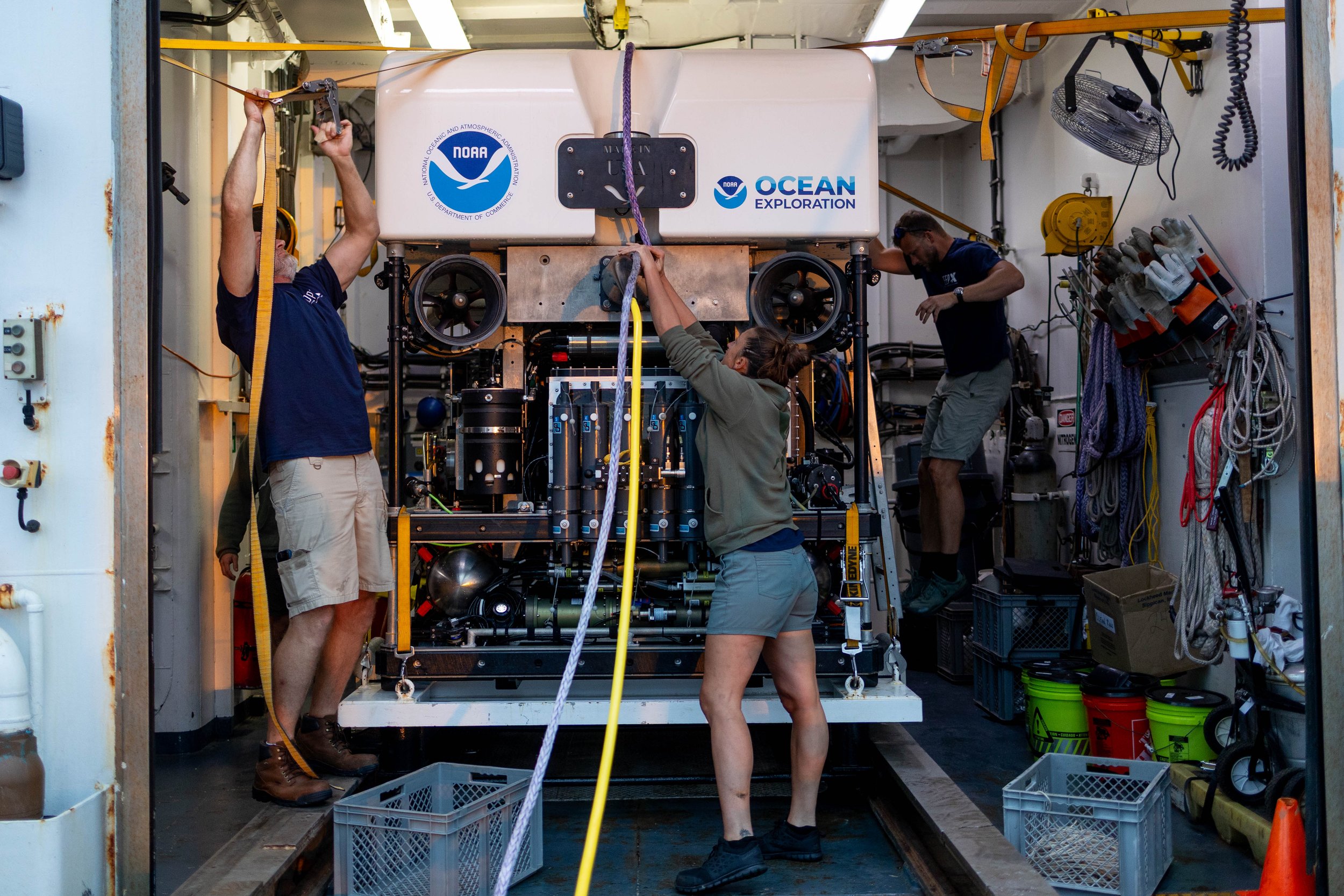
Pack it up: Bret Whitman, Sarah Haberstroh, and Chris Ritter secure D2 in the hangar after another successful day on the seafloor.
Learn more about ROV Deep Discoverer (D2) here.
Learn more about Chris Ritter and his expertise in underwater robotics at Ritter Designs.